



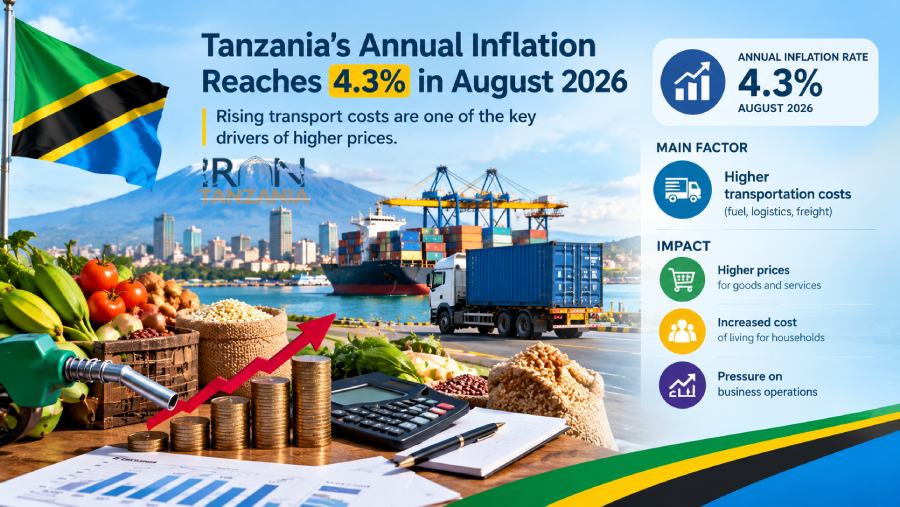
Tanzania’s annual headline inflation rate rose to 4.3% in August 2026, up slightly from 4.2% in July 2026, according to the latest data released by the National Bureau of Statistics (NBS).
The August figure was the highest annual inflation rate recorded during the August 2025–August 2026 period. Transport remained one of the most significant sources of price pressure, with the sector recording an annual inflation rate of 13.8%.
Transport Remains a Major Source of Price Pressure
According to Tanzania’s National Consumer Price Index (NCPI), the transport category recorded 13.8% year-on-year inflation in August 2026, the highest annual inflation rate among the major consumption groups.
Transport costs are particularly important for businesses because they directly affect the movement of imported goods, domestic distribution, logistics and supply chains.
Higher transportation expenses can therefore influence the final cost of products and services across different sectors of the economy.
Food Inflation Eased in August
While overall inflation increased, food and non-alcoholic beverage inflation moved in the opposite direction.
The annual inflation rate for food and non-alcoholic beverages declined to 3.7% in August 2026, compared with 4.1% in July.
This suggests that the latest increase in headline inflation was not primarily driven by food prices, while non-food categories—particularly transport—continued to create significant price pressure.
Inflation Rates Across Major Categories
The NBS reported the following annual inflation rates for selected consumption categories in August 2026:
- Transport: 13.8%
- Housing, water, electricity, gas and other fuels: 2.5%
- Furnishings and household equipment: 2.6%
- Education services: 3.2%
- Restaurants and accommodation services: 3.0%
- Food and non-alcoholic beverages: 3.7%
- Clothing and footwear: 1.8%
Core inflation also increased to 4.1% in August, compared with 3.9% in July.
What Does This Mean for Businesses in Tanzania?
For companies operating in Tanzania, transportation and logistics costs are becoming increasingly important factors in pricing and supply-chain planning.
Businesses involved in importing, exporting and domestic distribution need to consider not only the product price but also freight, insurance, warehousing, inland transportation and delivery conditions when calculating their final costs.
For international suppliers entering the Tanzanian market, efficient logistics planning can therefore play an important role in maintaining competitive prices.
Implications for Iran–Tanzania Trade
The latest inflation figures do not necessarily reduce the attractiveness of the Tanzanian market. Instead, they highlight the importance of accurate market research and cost management.
For Iranian exporters, sectors such as petrochemicals, chemicals, construction materials, industrial machinery, pharmaceutical products, food products and technical and engineering services can be explored as potential areas for trade with Tanzania.
However, successful market entry requires careful assessment of local demand, product pricing, logistics costs, distribution channels and purchasing power.
Conclusion
Tanzania’s annual headline inflation increased slightly to 4.3% in August 2026, compared with 4.2% in July. Transport remained a major source of price pressure, recording 13.8% annual inflation.
For businesses engaged in Tanzania’s import, export and distribution markets, the figures underline the importance of logistics planning, competitive pricing and efficient supply-chain management.
For Iranian companies considering Tanzania as an export or investment destination, understanding these cost dynamics can help improve pricing decisions and reduce market-entry risks.
Source: National Bureau of Statistics (NBS), Tanzania – National Consumer Price Index, August 2026.
