



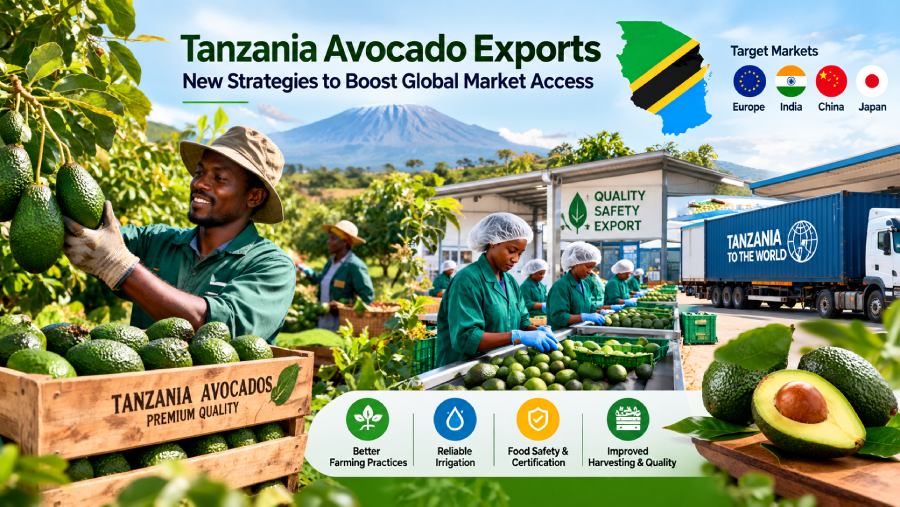
Tanzania Avocado Exports: New Strategies to Expand Global Market Access
Tanzania’s avocado exporters and agricultural stakeholders are exploring new strategies to increase avocado exports and strengthen the country’s position in international markets.
During a training programme focused on food safety standards and certification systems for small and medium-sized enterprises in Tanzania’s avocado value chain, industry stakeholders highlighted the need for better farming practices, reliable irrigation, proper harvesting and stronger compliance with food-safety standards.
The programme was organised with the participation of the Food and Agriculture Organization of the United Nations (FAO) and Tanzania’s Ministry of Agriculture.
Why Is Tanzania Seeking to Increase Avocado Exports?
Tanzania has significant potential to expand its horticultural production and exports, with avocados becoming an increasingly important agricultural export product.
A 2026 study found that Tanzania’s avocado exports increased from approximately 1,393 tonnes in 2013 to more than 29,000 tonnes in 2022. Export value also increased from around $11 million in 2021 to approximately $77 million in 2023.
This growth highlights the potential of avocados to contribute further to Tanzania’s export earnings, rural employment and agricultural value chains.
Fruit Quality Remains a Key Export Challenge
One of the major challenges facing Tanzania’s avocado industry is increasing the share of fruit that meets international export standards.
According to Joseph Muita, Managing Director of Fresh Agro Tanzania Limited, only around 40 percent of the fresh fruit currently handled by his company qualifies for export.
The figure highlights an important point: increasing production alone is not enough to expand Tanzania’s avocado exports. The quality and export readiness of the fruit must also improve.
Improving export quality requires better orchard management, appropriate varieties, pest management, irrigation, proper harvesting, grading, packaging and post-harvest handling.
The Importance of Reliable Irrigation
Reliable access to water and effective irrigation systems are important for improving the consistency and quality of avocado production.
For exporters, stable production is particularly important because international buyers require consistent volumes and quality within specific delivery periods.
Alongside irrigation, farmer training in production techniques, harvesting practices and post-harvest handling can help increase the proportion of fruit suitable for export.
Food Safety Standards and Export Certification
Another critical factor in the development of Tanzania’s avocado exports is compliance with food-safety standards and export certification requirements.
International markets often require fresh agricultural products to meet strict standards related to food safety, traceability, quality, packaging and supply-chain management.
Recent research on Tanzania’s avocado value chain also highlights the role of exporters in washing, sorting, grading, quality control and meeting regulatory requirements for international markets.
Strengthening packhouse infrastructure, certification systems and farmer training could therefore help Tanzania increase its access to higher-value export markets.
Tanzania Targets New International Avocado Markets
Market diversification is also becoming an important part of Tanzania’s avocado export strategy.
According to the Embassy of Tanzania in Japan, Tanzania is looking to expand avocado exports to Japan, while already targeting established markets in Europe, China and India.
Discussions between Tanzanian agricultural stakeholders and the Embassy in Tokyo focused on agricultural value addition, market access and opportunities to strengthen trade in high-quality Tanzanian agricultural products.
This indicates that Tanzania’s avocado strategy is not limited to increasing production. Expanding into new markets and reaching higher-value consumers are also becoming increasingly important.
Reducing Food Loss and Waste
Reducing losses across the avocado value chain represents another opportunity for Tanzania to increase export volumes without relying solely on higher production.
A 2026 study of Tanzania’s export avocado value chain found that food loss and waste are influenced not only by technical factors, but also by harvesting decisions, grading practices, pricing transparency, contractual relationships and the distribution of risks between farmers and exporters.
Improving coordination between farmers, cooperatives, exporters, packhouses and government institutions could therefore help reduce losses and improve the efficiency of the export supply chain.
Business Opportunities in Tanzania’s Agricultural Sector
The growth of Tanzania’s avocado industry could create opportunities beyond the export of fresh fruit itself.
Potential areas for international companies include:
- Irrigation systems and agricultural equipment
- Sorting and packaging machinery
- Cold-chain technologies
- Agricultural processing equipment
- Farm inputs and agricultural technologies
- Food-safety and quality-control solutions
- Technical and engineering services
- Post-harvest handling technologies
For Iranian companies, the development of Tanzania’s agricultural value chains could also create opportunities for technology cooperation, equipment supply, technical services and agricultural trade.
Outlook for Tanzania’s Avocado Exports
Tanzania is working to transform its avocado production potential into a stronger presence in global markets.
However, sustainable export growth will depend on a combination of better farming practices, reliable irrigation, improved harvesting, higher fruit quality, food-safety compliance, reduced post-harvest losses and greater diversification of export markets.
If these improvements are implemented across the value chain, the avocado industry could play an increasingly important role in Tanzania’s agricultural development, rural employment and export revenues.
Main source: The Citizen Tanzania, 11 September 2026.
Additional sources: Embassy of Tanzania in Japan, Springer Nature and Frontiers in Sustainable Food Systems.
