



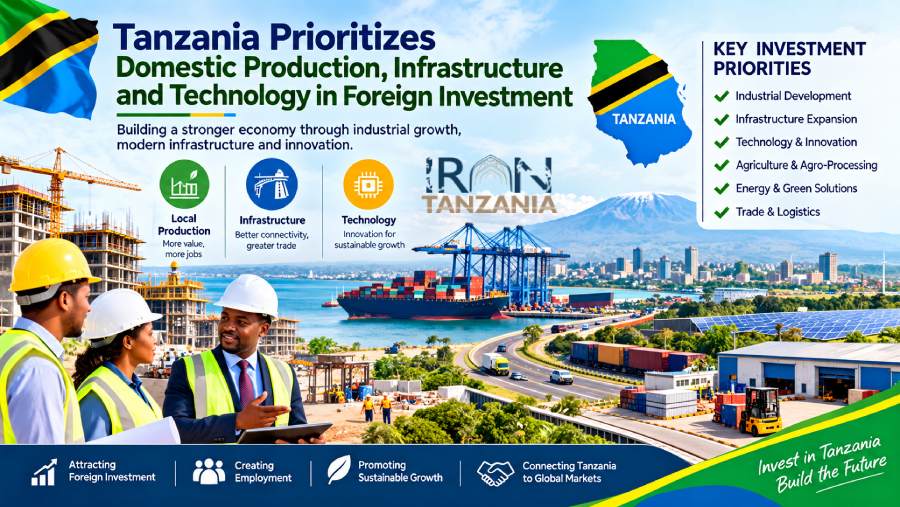
The development of local production, infrastructure and technology is becoming central to Tanzania’s foreign investment strategy. The country is seeking to attract foreign direct investment to expand productive capacity, increase domestic value addition and strengthen its position as an investment destination in East and Southern Africa.
According to Tanzania’s official investment institutions, attracting investment is not limited to securing financial capital. Technology transfer, employment creation, workforce development, export expansion and import substitution are also important objectives of the country’s investment framework.
Why Is Tanzania Seeking Foreign Investment?
Tanzania has considerable potential in natural resources, agriculture, consumer markets, geographical connectivity and access to regional trade routes. However, converting these advantages into sustainable economic growth requires stronger domestic industries and more developed value chains.
Foreign investment can support Tanzania through:
-
Establishing new production facilities;
-
Expanding existing industrial capacity;
-
Developing transport and energy infrastructure;
-
Transferring technology and technical expertise;
-
Creating skilled employment;
-
Improving product quality and standards;
-
Expanding exports of goods and services; and
-
Reducing dependence on selected imported products.
From this perspective, a foreign investor is not only a source of finance. It can also contribute to technology development, management expertise, workforce training and the integration of local producers into international markets.
Focus on Local Manufacturing and Industrialisation
Strengthening the industrial base and increasing domestic production are important elements of Tanzania’s investment agenda. Official investment institutions identify manufacturing, light industries, metal products, machinery, transport equipment, chemicals, paper, plastics, electrical appliances and electronics among the sectors with investment potential.
The expansion of local production can generate several benefits.
1. Creating Domestic Value Addition
Instead of exporting raw materials, investment in processing and manufacturing can generate greater economic value inside Tanzania. Agricultural products, minerals and natural resources can be processed, packaged and transformed into products with higher export value.
2. Reducing Dependence on Imports
Domestic manufacturing of consumer goods, industrial inputs, machinery and intermediate products can help meet part of Tanzania’s market demand and reduce reliance on imports.
3. Creating Jobs and Developing Skills
Factories and industrial projects can create direct employment while also supporting technical training in production management, quality control, maintenance and specialised services.
4. Expanding Regional Exports
Production facilities located in Tanzania may serve both the domestic market and markets in East and Southern Africa. However, access to regional trade benefits depends on rules of origin, product standards and customs requirements.
Infrastructure as a Key Investment Priority
Infrastructure is essential for the success of foreign investment projects. Transport, energy, ports, roads, warehousing, digital connectivity and urban services directly affect business costs and productivity.
Because Tanzania is located along the Indian Ocean and has important ports, it has the potential to serve as a logistics platform for countries in East, Central and Southern Africa. Investment opportunities may therefore emerge in areas such as:
-
Port development and modernisation;
-
Roads and transport corridors;
-
Railways and freight transportation;
-
Modern warehouses and distribution centres;
-
Cold-chain infrastructure;
-
Electricity generation and transmission;
-
Renewable energy;
-
Digital and telecommunications infrastructure; and
-
Industrial parks and production zones.
Improved infrastructure can make large-scale projects more efficient and reduce the overall cost of producing and distributing goods.
The Role of Special Economic Zones
Tanzania is using Special Economic Zones (SEZs) and Export Processing Zones (EPZs) to create a more supportive environment for manufacturing and export-oriented businesses.
Official information indicates that SEZs may cover manufacturing, agriculture, trade, tourism, mining, forestry and services. The use of modern production processes, new machinery, environmental protection systems and the location of projects within industrial parks are among the criteria associated with certain investment schemes.
For investors, special economic zones may offer:
-
Access to serviced land or industrial premises;
-
Support with selected administrative procedures;
-
Potential investment incentives;
-
Proximity to transport infrastructure;
-
Better access to industrial services;
-
Clusters of manufacturers and suppliers; and
-
Improved connections to export and supply-chain networks.
The exact incentives, licensing requirements, minimum investment levels and export obligations must be confirmed for each project with the relevant authority.
Technology Transfer and Technical Expertise
A major difference between purely financial investment and development-oriented investment is the extent to which technology and expertise are transferred to the host economy.
Tanzania’s investment framework identifies new technology, productivity improvement, export-oriented production and skills transfer as important considerations for certain strategic investment projects.
Potential technology-related areas include:
Manufacturing Technology
-
Production-line automation;
-
Digital quality control;
-
Energy-efficient equipment;
-
Production management systems; and
-
Predictive maintenance.
Agricultural Technology
-
Smart irrigation;
-
Precision agriculture;
-
Agro-processing equipment;
-
Packaging and grading systems; and
-
Food-loss reduction technologies.
Energy Technology
-
Solar power systems;
-
Electricity storage equipment;
-
Smart-grid solutions;
-
Energy-efficiency technologies; and
-
Power solutions for industrial areas.
Digital and Communication Technology
-
E-commerce;
-
Digital financial services;
-
Supply-chain management software;
-
Customs and logistics platforms;
-
Data centres and cloud services; and
-
Online education and digital skills development.
Institutional Reforms and Investment Facilitation
In 2025, Tanzania introduced a new framework for investment and special economic zones and established the Tanzania Investment and Special Economic Zones Authority (TISEZA) as the main institution responsible for coordinating, facilitating and promoting investment.
The reforms aim to integrate selected investment-related functions and improve the delivery of services required by investors. The framework also includes plans for an integrated system connecting licensing and approval authorities, as well as the development of an investment-ready land bank.
For foreign investors, a coordinating institution can be useful for:
-
Obtaining information about investment opportunities;
-
Reviewing project requirements and permits;
-
Identifying suitable land or industrial premises;
-
Registering a company;
-
Obtaining operating licences;
-
Reviewing investment incentives; and
-
Coordinating with relevant government agencies.
Nevertheless, investors should verify current environmental, tax, labour, land, customs and sector-specific regulations before making financial commitments.
Potential Opportunities for Iranian Companies
Tanzania’s focus on local manufacturing, infrastructure and technology may create areas for Iranian companies to explore. These opportunities should be assessed through market research, competitiveness analysis, landed-cost calculations, import regulations and the possibility of working with local partners.
Potential areas include:
-
Industrial machinery and equipment;
-
Agricultural and irrigation equipment;
-
Food-processing and packaging technologies;
-
Chemicals and petrochemical products;
-
Bitumen and construction-related materials;
-
Energy and electrical equipment;
-
Water-treatment systems;
-
Warehousing and cold-chain equipment;
-
Engineering and technical services;
-
Production and trade-management software; and
-
Technical training and specialised knowledge transfer.
Iranian companies may enter the Tanzanian market through several models:
-
Direct export of products and equipment;
-
Cooperation with local distributors or agents;
-
Establishing a commercial office or company;
-
Joint ventures with Tanzanian partners;
-
Participation in infrastructure projects;
-
Technology transfer and technical services; or
-
Establishing production or assembly facilities in industrial zones.
Important Considerations Before Investing in Tanzania
Before entering an investment project, companies should carefully evaluate:
-
Actual market demand;
-
Customer purchasing power;
-
Competitors and substitute products;
-
Transport and logistics costs;
-
Access to electricity, water and labour;
-
Company registration and tax regulations;
-
Land ownership and land-use rules;
-
Licensing and product standards;
-
Contract enforcement and dispute resolution;
-
Profit repatriation and foreign exchange rules;
-
Currency and financing risks; and
-
The capacity of local partners and distribution networks.
Investment in a special economic zone or access to incentives does not automatically guarantee project profitability. Success depends on the business model, management quality, execution capacity, target market and cost control.
Conclusion
Tanzania is increasingly directing foreign investment toward local production, infrastructure development, technology transfer, employment creation and export growth. The development of special economic zones, the promotion of industrial opportunities and reforms in investment facilitation are part of the country’s efforts to improve its business environment.
For international investors, Tanzania can represent both an important domestic market and a platform for reaching markets across East and Southern Africa. Companies that align their capital, technology, expertise and management capabilities with Tanzania’s actual market needs may be better positioned to build sustainable partnerships and expand regionally.
Main source: Tanzania Investment and Special Economic Zones Authority (TISEZA) Supporting references: Tanzania Investment Centre, UNCTAD and the World Bank
