



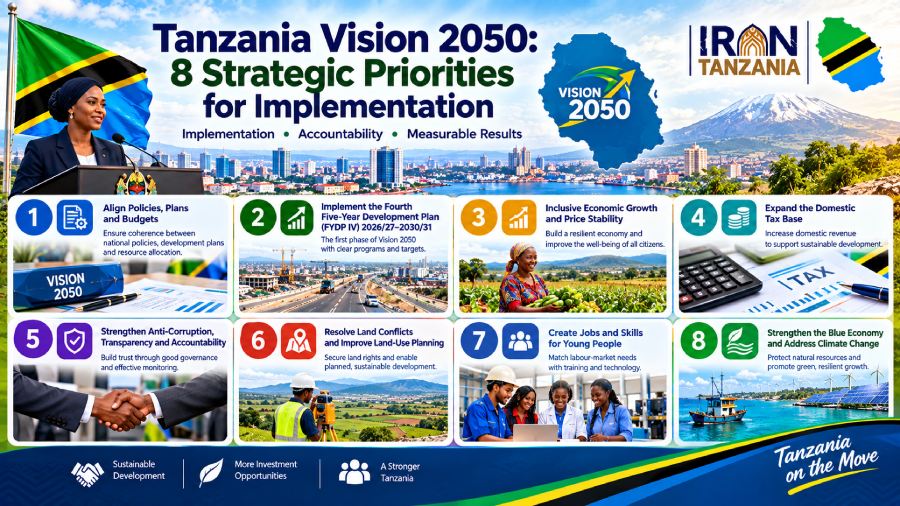
Tanzania has identified eight strategic priorities for implementing Vision 2050, with a strong focus on implementation, accountability, monitoring and measurable development outcomes.
According to The Citizen, the priorities were outlined during the National Planners’ Conference held in Arusha on September 16–17, 2026. The government emphasized the need to translate Vision 2050 from long-term policy objectives into practical plans, budgets and development projects.
What Is Tanzania Vision 2050?
Tanzania Development Vision 2050 is the country’s long-term development framework aimed at guiding economic transformation, investment, human development and structural development through 2050.
The Fourth National Five-Year Development Plan (FYDP IV), covering 2026/27–2030/31, represents the first phase of implementing Vision 2050.
The National Planning Commission has also been developing monitoring and evaluation mechanisms and implementation tools to track progress under Vision 2050.
The 8 Strategic Priorities for Tanzania Vision 2050
1. Align Policies, Plans and Budgets
The first priority is to align national policies, development plans and budgets so that government institutions work toward common national objectives.
The government has also emphasized the timely completion of flagship projects within planned costs and required standards.
2. Implement the Fourth Five-Year Development Plan
The second priority is the implementation of FYDP IV for 2026/27–2030/31, which is the first implementation phase of Vision 2050.
According to The Citizen, the plan is linked to Tanzania’s long-term ambition of building a $1 trillion economy and reaching annual per-capita income of $7,000 by 2050. These are long-term targets rather than guaranteed outcomes.
3. Promote Inclusive Economic Growth and Price Stability
The third priority focuses on inclusive economic growth and price stability.
The Citizen reported that Tanzania’s economy grew by 5.9% in 2025, compared with 5.6% in 2024, while inflation remained within the reported 3–5% target range.
The policy focus is therefore not only on economic expansion, but also on ensuring that growth contributes to employment, income generation and broader economic participation.
4. Expand the Domestic Tax Base
The fourth priority is to expand Tanzania’s domestic tax base.
The government intends to implement recommendations from the Presidential Commission on Tax Reforms to strengthen domestic revenue collection and support development programs while reducing reliance on external sources.
5. Strengthen Transparency, Accountability and Anti-Corruption Measures
The fifth priority focuses on strengthening transparency, accountability and the management of public resources.
Government planners have been urged to consider recommendations from oversight and anti-corruption institutions.
This is also connected to Tanzania’s broader efforts to establish stronger monitoring and evaluation systems for Vision 2050 implementation.
6. Resolve Land Conflicts and Improve Land-Use Planning
The sixth priority is to address land conflicts and improve land-use planning.
According to The Citizen, this is intended to facilitate investment in areas such as:
- Agriculture
- Livestock
- Manufacturing
- Housing
- Development projects
Clearer land-use planning can also be relevant to foreign investors assessing the feasibility and regulatory environment of long-term projects.
7. Create Jobs and Skills for Young People
The seventh priority focuses on youth employment and skills development.
Training is expected to become more closely aligned with labour-market requirements and technological change.
This creates potential relevance for sectors such as manufacturing, technology, engineering services, logistics, energy, agriculture and industrial processing.
8. Strengthen the Blue Economy and Address Climate Change
The eighth priority focuses on strengthening the Blue Economy while addressing climate change.
Potential areas include marine activities, fisheries, maritime transport, coastal tourism and other economic activities related to water resources.
Climate-focused development may also increase attention to renewable energy, green technologies, sustainable infrastructure and climate-resilient development.
The Citizen linked this priority to innovation, economic growth, environmental protection and sustainable development.
From Development Plans to Measurable Results
One of the most important aspects of Tanzania’s Vision 2050 implementation approach is the emphasis on measurable results rather than plans alone.
The Citizen reported that the government wants the success of Dira 2050 to be assessed through outcomes such as jobs, higher incomes, improved services, lower costs, increased production and greater economic opportunities.
Tanzania’s National Planning Commission has also introduced the e-Delivery system for monitoring national development projects. In September 2026, the commission reported that 150 development projects had already been registered in the system, with the broader system intended to improve transparency, accountability, efficiency and project monitoring.
Tanzania Vision 2050 and Investment Opportunities
The implementation of these priorities may create areas of interest for international investors and suppliers.
Manufacturing
Domestic production and value addition can create demand for industrial machinery, equipment, raw materials and technical services.
Agriculture and Agro-Processing
Agricultural production, processing, packaging, cold-chain systems and agricultural equipment may benefit from Tanzania’s development priorities.
Infrastructure and Energy
Development programs require infrastructure in transport, energy, water, communications and digital systems.
Technology and Skills
The focus on youth skills and technological change creates opportunities in vocational training, digital solutions, industrial technology and knowledge transfer.
Blue Economy and Green Technologies
Tanzania’s coastal location and focus on the Blue Economy and climate resilience can create potential areas for cooperation in renewable energy, maritime services, fisheries, environmental technologies and sustainable tourism.
Why Vision 2050 Matters to Iranian Companies
For Iranian companies exploring the Tanzanian and wider African markets, understanding Vision 2050 and FYDP IV can provide an additional framework for identifying sectors that are receiving policy attention.
Potentially relevant industries include:
- Industrial machinery
- Agricultural equipment
- Energy and renewable energy
- Food processing
- Construction materials
- Engineering and technical services
- Industrial inputs
- Digital technologies
- Training and skills development
However, a development priority does not automatically represent a confirmed commercial opportunity. Companies should conduct detailed market research, regulatory due diligence, partner verification, tender analysis and demand assessment before entering the market.
Conclusion
Tanzania Vision 2050 has entered its implementation phase with eight strategic priorities covering economic growth, development planning, public accountability, land management, employment, domestic revenue and the Blue Economy.
The combination of policy alignment, FYDP IV implementation, measurable outcomes and stronger monitoring systems is intended to translate the long-term Vision 2050 framework into concrete development projects and economic results.
For international companies, these priorities can serve as a starting point for identifying potential opportunities in investment, exports, industrial equipment, infrastructure, technology and business cooperation with Tanzania.
Main source: The Citizen, September 21, 2026, supported by Tanzania’s National Planning Commission resources on Vision 2050 implementation.
