



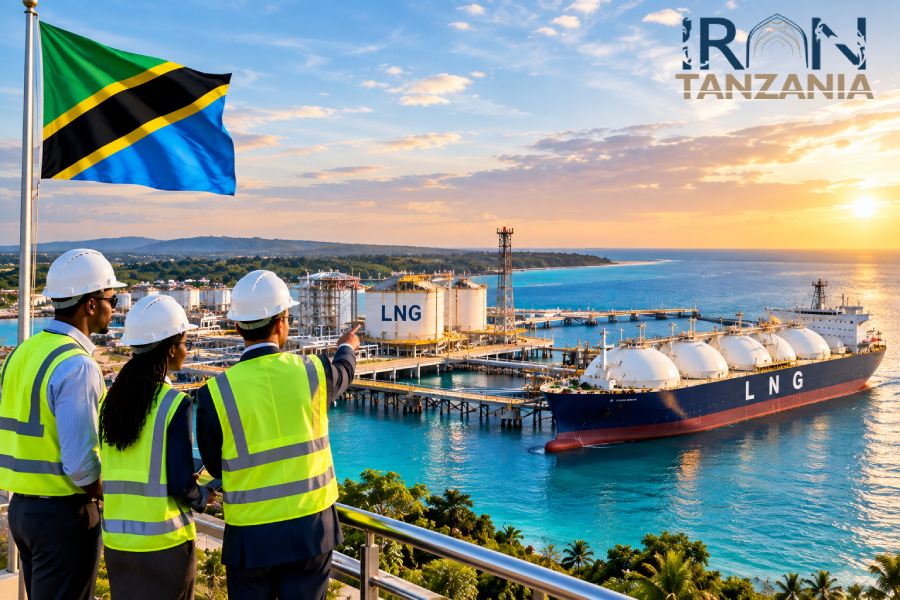
Tanzania’s planned $42 billion Liquefied Natural Gas (LNG) project has entered its final legal stage after the government and investors concluded key commercial negotiations.
According to The Citizen, negotiations covering the project’s scale, taxation, commercial operations and revenue-sharing arrangements were completed during the 2025/26 financial year.
Legal teams are now meeting in Arusha to finalise the Host Government Agreements and the legislation required to govern implementation before the documents proceed through government review, ratification and parliamentary approval.
What Stage Is Tanzania’s LNG Project At?
The LNG project is planned for Lindi Region in southern Tanzania.
The commercial negotiation phase has now been completed, but the project has not yet entered construction. The immediate focus is the completion of the legal and regulatory framework required for implementation.
TPDC Managing Director Mussa Makame said the commercial negotiations had concluded and that the remaining work involves the Host Government Agreements and legislation.
Therefore, reaching the final legal stage should not be interpreted as an immediate start of construction or as confirmation that the project has already reached a Final Investment Decision. It is an important step toward those subsequent milestones.
How Much Is Tanzania’s LNG Project Worth?
The project is currently estimated at approximately $42 billion.
It is one of Tanzania’s largest proposed energy investments and is designed to develop the country’s natural gas resources for LNG production and export.
Reuters reported in August 2026 that the project could unlock approximately 47.13 trillion cubic feet of natural gas resources.
Reuters also reported that Equinor and Shell are joint operators, while ExxonMobil, Pavilion Energy, Medco Energi and Tanzania’s TPDC are partners in the project.
What Commercial Issues Have Been Negotiated?
The negotiations between Tanzania and international investors have covered several key areas.
According to the latest report, these include:
- Project scale
- Taxation
- Commercial operations
- Revenue sharing
- Investment terms
- Legal framework
- Project implementation arrangements
The commercial negotiations were completed during the 2025/26 financial year, with the focus now shifting toward converting the negotiated commercial terms into legally binding agreements and legislation.
What Is the Host Government Agreement?
The Host Government Agreement (HGA) is one of the key legal instruments required for the project.
It establishes important terms governing the relationship between the Tanzanian government and the project investors.
In 2022, Tanzania signed a preliminary HGA agreement with Shell and Equinor. Tanzania’s Petroleum Upstream Regulatory Authority said at the time that the project would be implemented at Likong’o in Lindi Region.
The government also highlighted the importance of building Tanzanian capacity and ensuring that local communities and workers benefit from the development.
Why Is the Final Legal Stage Important?
For a project worth tens of billions of dollars, a clear legal framework is critical.
The final agreements help define:
- Government and investor obligations
- Tax arrangements
- Revenue-sharing mechanisms
- Project operating rules
- Local participation requirements
- Long-term responsibilities of project partners
For this reason, the completion of commercial negotiations and the move into the final legal phase represent an important development, although formal approvals and subsequent investment decisions are still required.
Tanzania Focuses on Local Content
One of the most important elements of the latest development is the government’s focus on Local Content.
The Prime Minister’s Office has established a dedicated team to prepare a Local Content Strategy and Plan for the LNG project.
The strategy is intended to increase Tanzanian participation in:
- Employment
- Skills development
- Business opportunities
- Construction services
- Transport
- Catering
- Engineering
- Maintenance
- Supply-chain activities
The Citizen reported that local content could determine how much of the project’s economic impact remains within Tanzania rather than flowing primarily to international contractors and suppliers.
Potential Business Opportunities Around Tanzania LNG
A project of this scale can create demand well beyond LNG production itself.
Potential areas include:
Industrial and Energy Equipment
Process equipment, gas transmission equipment, control systems, instrumentation and energy equipment.
Engineering and Technical Services
Engineering design, consulting, installation, maintenance and specialist technical services.
Construction and Infrastructure
Construction machinery, materials, project equipment and civil engineering services.
Transport and Logistics
Heavy equipment transport, port services, warehousing and supply-chain logistics.
Support Services
Catering, accommodation, safety services, training and general project support.
Technology
Digital systems, industrial automation, project monitoring and data-driven solutions.
Tanzania’s Wider Natural Gas Development
The LNG project is part of Tanzania’s broader strategy to develop its oil and gas value chain.
According to The Citizen, TPDC is expanding activities across exploration, production, processing, transportation and distribution.
Tanzania’s Songo Songo and Mnazi Bay gas blocks currently produce approximately 170 million cubic feet of natural gas per day, with around 85% of that output used for electricity generation.
TPDC is also developing gas infrastructure and exploring ways to expand gas distribution to industrial and domestic consumers.
Tanzania’s Ambition to Become a Regional Energy Hub
Tanzania’s gas strategy extends beyond LNG exports.
TPDC says it is pursuing gas export links with Kenya, Uganda and Zambia, while discussions are also taking place regarding a gas connection with Mozambique.
If developed, these connections could strengthen Tanzania’s position within the regional energy infrastructure network.
Why Does Tanzania LNG Matter for Foreign Investment?
The LNG project is significant for Tanzania’s investment environment for several reasons.
First, the project represents a very large potential capital investment.
Second, its development requires infrastructure in energy, gas processing, transportation and technical services.
Third, the Local Content Strategy could create additional participation opportunities for Tanzanian businesses and workers.
Fourth, LNG development could strengthen Tanzania’s role in regional and international natural gas markets.
However, the actual economic impact will depend on final legal approvals, investment decisions, financing, construction schedules and project execution.
Opportunities for Iranian Companies
For Iranian companies exploring Tanzania and East African markets, the LNG project can be examined from a supply-chain and industrial-services perspective.
Potentially relevant sectors include:
oil and gas equipment, industrial machinery, valves, pumps, compressors, electrical equipment, instrumentation, safety equipment, construction materials, engineering services, transportation and logistics.
However, participation in a project of this scale requires detailed analysis of tenders, EPC contractors, Local Content requirements, technical standards, import regulations, financing conditions and official procurement channels.
A sector being part of the LNG supply chain does not automatically mean that a confirmed purchase opportunity exists. Companies should assess specific procurement opportunities and project contractors before entering the market.
