



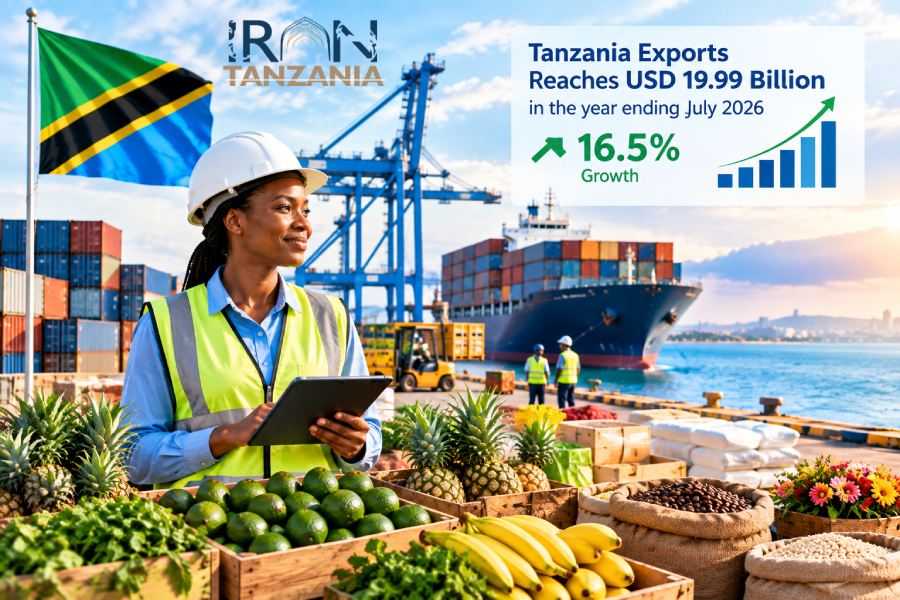
Tanzania is strengthening commercial agriculture and agricultural value chains as it seeks to expand its role as a major food supplier in East Africa. As part of this broader development, a TZS 10 billion financing facility has been established to support businesses across the agricultural value chain, including production, mechanisation, processing, storage and distribution.
The development comes as Tanzania continues to expand agricultural production, infrastructure, processing capacity and private-sector investment in an effort to strengthen both domestic food supply and regional agricultural trade.
Tanzania’s Goal to Become East Africa’s Food Basket
Agriculture remains one of the key sectors of Tanzania’s economy, while recent policies and investment initiatives have increasingly focused on commercial agriculture, productivity, value addition and agricultural value chains.
Recent reports in September 2026 highlighted Tanzania’s ambition to strengthen its position as a major food supplier to East Africa.
According to The Citizen, Tanzania’s food-crop production reached approximately 23.78 million tonnes in the 2024/25 season, while the country’s food self-sufficiency ratio was reported at 130 percent, representing a surplus of more than 5.5 million tonnes.
This production capacity provides a foundation for expanding agricultural exports as well as developing downstream agro-processing industries.
Commercial Agriculture Beyond Farm Production
Tanzania’s agricultural strategy is increasingly focused not only on producing more crops but also on developing a connected value chain.
The broader agricultural ecosystem includes:
Production → Machinery → Processing → Packaging → Storage → Transport → Distribution → Domestic and Export Markets
This integrated approach is important because higher production alone does not necessarily create higher economic value without adequate storage, processing capacity, transportation and market access.
Recent reporting on Tanzania’s agricultural development strategy has highlighted irrigation, infrastructure, agricultural inputs, processing and private investment as important components of agricultural transformation.
TZS 10 Billion Facility to Support Tanzania’s Agricultural Value Chain
One of the latest developments is a strategic partnership between Tanzania Agricultural Development Bank (TADB) and NCBA Bank Tanzania.
Under the partnership, TADB has provided NCBA Bank Tanzania with a TZS 10 billion term facility, supported by a credit guarantee arrangement designed to expand lending to eligible agricultural businesses.
The significance of the facility is that financing is intended to extend beyond primary farm production.
It can support businesses operating across different stages of the agricultural value chain, including:
- Agricultural production
- Mechanisation
- Machinery investment
- Processing
- Storage
- Distribution
- Business expansion
- Market access
Why Agricultural Value-Chain Financing Matters
Access to finance is critical for commercial agriculture because businesses often require capital at multiple stages of the production cycle.
A farmer may have the potential to increase production but lack access to tractors, irrigation equipment or harvesting machinery.
Similarly, a producer may generate sufficient agricultural output but lose part of its economic value because of inadequate storage, cold-chain infrastructure or processing capacity.
Financing across the value chain can therefore help connect production with markets.
TADB’s previous financing activities have also supported areas such as mechanisation, warehouses, cold storage and agro-processing facilities.
Agro-Processing and Agricultural Value Addition
One of the most important opportunities within Tanzania’s agricultural sector is agro-processing.
Instead of selling agricultural products in raw form, processing can increase their economic value and create additional business opportunities.
Potential areas include:
Food Crops
- Maize
- Rice
- Wheat
- Pulses
Horticultural Products
- Avocados
- Bananas
- Pineapples
- Vegetables
- Tropical fruits
Traditional and Export Crops
- Coffee
- Cashew nuts
- Cotton
- Tea
- Tobacco
- Sisal
Processing Industries
- Edible oils
- Grain milling
- Fruit processing
- Dairy processing
- Food packaging
- Animal feed
Recent reports on Tanzania’s agricultural investment opportunities have highlighted gaps in areas such as grain milling, edible oils, dairy and horticultural processing.
Agricultural Machinery Is a Key Market Opportunity
Commercial agriculture requires greater mechanisation and modern technology.
Greater access to tractors, harvesting equipment, irrigation systems, processing machinery and agricultural technologies can help improve productivity.
Tanzania’s Ministry of Agriculture has also highlighted smart agriculture and modern technologies as tools for improving agricultural productivity.
This creates potential opportunities for suppliers of:
- Tractors
- Combine harvesters
- Planting and harvesting equipment
- Irrigation systems
- Processing machinery
- Packaging equipment
- Cold-storage systems
- Warehouse equipment
Storage and Distribution: Critical Links in the Food Chain
Producing more food is not enough to become a major regional food supplier.
Tanzania also needs efficient networks of:
Warehouses, cold-storage facilities, distribution centres, food transportation and logistics services.
This is particularly important for perishable products such as fruits and vegetables.
TADB’s previous agricultural financing programmes have included support for warehouses, cold storage and post-harvest management.
Investment Opportunities in Tanzania’s Agricultural Sector
The combination of agricultural production capacity, domestic demand and regional market access creates opportunities across several areas.
1. Commercial Farming
Development of large-scale and mechanised farms for food and export crops.
2. Agricultural Machinery
Supplying mechanisation equipment to improve productivity and reduce production costs.
3. Agro-Processing
Establishing processing facilities that convert raw agricultural commodities into higher-value products.
4. Food Packaging
Developing modern packaging solutions for domestic and export markets.
5. Cold Chain
Cold-storage and temperature-controlled logistics for horticulture, dairy, meat and other perishable products.
6. Warehousing and Logistics
Developing storage and distribution networks connecting production areas with domestic and regional markets.
7. Agricultural Technology
Smart irrigation, farm-management technologies, agricultural data systems and modern production technologies.
Opportunities for Iranian Companies
The transformation of Tanzania’s agricultural sector may also create opportunities for Iranian companies involved in agricultural machinery, food processing, industrial equipment and technical services.
Potential areas include:
- Agricultural machinery
- Irrigation equipment
- Food-processing machinery
- Agricultural processing lines
- Packaging equipment
- Cold-storage systems
- Warehouse equipment
- Agricultural technologies
- Engineering services
- Technical know-how and technology transfer
For companies entering the Tanzanian market, however, product-market fit, import requirements, standards, pricing, local buyers and distribution partnerships should be assessed carefully.
Tanzania’s Agriculture and Regional Food Markets
Tanzania’s geographic position is another factor supporting its agricultural ambitions.
The country’s road, rail and port networks connect it with markets in East and Southern Africa, potentially strengthening its role in regional agricultural trade.
Therefore, Tanzania’s agricultural transformation is not limited to domestic food supply. It also has the potential to support regional exports and cross-border agricultural trade.
Agricultural initiatives such as AGCOT are also designed to attract investment and develop agricultural growth corridors.
Conclusion
Tanzania is moving toward an agricultural model in which production, mechanisation, processing, storage, distribution and market access are treated as interconnected parts of the same value chain.
The country’s ambition to become an “East Africa food basket”, combined with the expansion of commercial agriculture, investment and processing capacity, could strengthen Tanzania’s role in regional agricultural trade.
The TZS 10 billion TADB–NCBA financing facility is another development aimed at improving access to finance for agricultural businesses across production, mechanisation, processing, storage and distribution.
For Iranian companies, these developments provide areas to explore in agricultural machinery, food processing, packaging, cold-chain infrastructure, logistics and agricultural technologies.
