



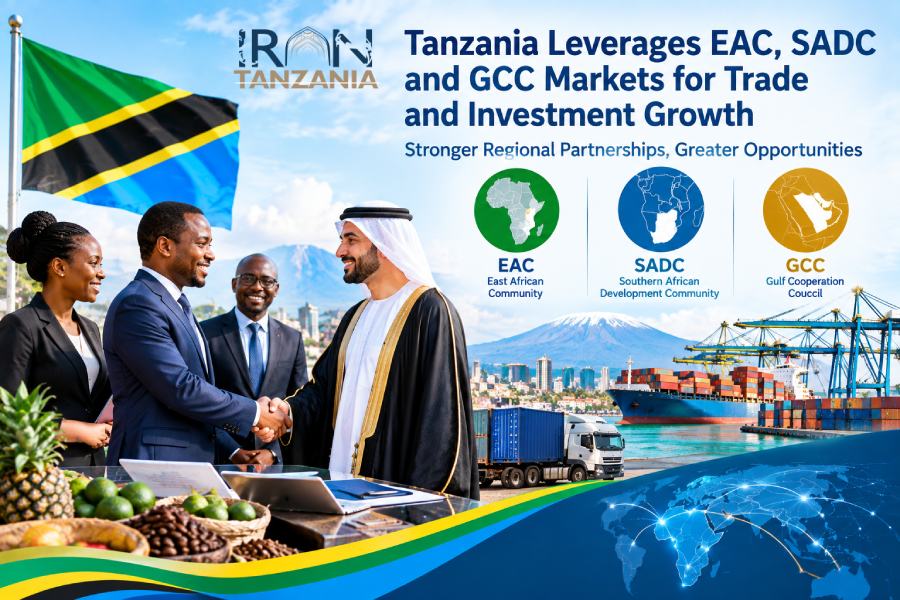
Tanzania is strengthening its strategy to use regional and international markets to expand trade, exports, services and investment.
A recent development highlights Tanzania’s efforts to leverage its membership in the East African Community (EAC) and the Southern African Development Community (SADC) while strengthening economic links with the Gulf region through Qatar and the Gulf Cooperation Council (GCC).
According to Tanzania’s Trade Development Authority (TanTrade), discussions during the Tanzanian Prime Minister’s recent visit to Qatar focused on expanding trade and investment opportunities between the two countries and using their regional positions to broaden market access and economic cooperation.
Why EAC and SADC Matter to Tanzania
Tanzania is a member of both the EAC and SADC, giving it connections to two major regional economic blocs in Africa.
The EAC had more than 331 million people and a combined GDP of approximately $357 billion in 2026. In the second quarter of 2026, total EAC trade reached $52.3 billion, while exports increased by 41.3% year-on-year.
Tanzania’s membership in SADC also strengthens its links with Southern African markets.
In 2026, SADC and Tanzania participated in initiatives to operationalise the Simplified Trade Regime, including activities along Tanzania’s borders with Malawi and Zambia to facilitate small-scale cross-border trade.
Tanzania as a Gateway Between East and Southern Africa
Tanzania’s geographical position is an important part of its regional trade strategy.
The country has access to the Indian Ocean and provides transport connections to several landlocked neighbouring countries, including:
- Uganda
- Rwanda
- Burundi
- Democratic Republic of Congo
- Zambia
- Malawi
The SADC Investment Portal highlights Tanzania’s three deep-water ports—Dar es Salaam, Tanga and Mtwara—and its road and rail connections as important factors supporting trade across Eastern, Southern and Central Africa.
Tanzania Strengthens Economic Links with Qatar and the GCC
Alongside African regional markets, Tanzania is seeking to strengthen economic ties with Gulf markets.
During the recent Tanzanian Prime Minister’s visit to Qatar, Tanzanian and Qatari officials discussed opportunities to use Tanzania’s position in the EAC and SADC and Qatar’s participation in the GCC to expand markets and economic cooperation.
The discussions also emphasised connecting Tanzanian and Qatari business communities through their representative institutions to identify strategic areas of cooperation and develop new investment opportunities.
Trade in Services Is Also Becoming a Priority
Tanzania’s strategy is not limited to merchandise exports.
TanTrade has also been instructed to identify and promote opportunities for Tanzanian services in international markets, including professional services and human resources.
The country’s Ministry of Industry and Trade has stressed that international trade should include services that Tanzanian professionals and companies can provide abroad.
Potential areas include:
- Professional services
- Engineering
- Logistics
- Transport
- Tourism
- Technical services
- Human resources
- Business services
Products with Regional and International Export Potential
Tanzania’s expanding market strategy can support a wide range of export sectors.
Agriculture
Potential products include:
- Coffee
- Avocados
- Cashew nuts
- Legumes
- Cloves
- Horticultural products
Minerals
- Gold
- Nickel
- Graphite
- Gemstones
- Processed minerals
Manufacturing
- Processed food
- Consumer products
- Manufactured goods
- Packaged products
Services
- Logistics
- Engineering
- Professional services
- Tourism
- Skilled labour
Tanzania’s official Trade Portal provides procedures for exporting products such as cashew nuts, coffee, tea, cotton, avocados, flowers and other goods, including EAC and SADC certificates of origin.
Investment Opportunities in Tanzania
The expansion of regional and international market connections also has implications for foreign investment.
Tanzania has investment opportunities across sectors including:
- Manufacturing
- Agro-processing
- Commercial agriculture
- Mineral processing
- Energy
- Infrastructure
- Logistics
- Tourism
- Technology
Its Indian Ocean location and connections to East and Southern African markets are among the factors highlighted by SADC’s investment platform when presenting Tanzania as an investment location.
What This Means for Iranian Companies
Tanzania’s expanding links with EAC, SADC and Gulf markets can also be relevant to Iranian companies exploring African export opportunities.
Potential areas for Iranian businesses include:
- Petrochemical products
- Chemicals
- Pharmaceuticals
- Industrial equipment
- Mining machinery
- Agricultural machinery
- Food products
- Construction materials
- Energy equipment
- Engineering services
- Processing technologies
However, companies entering these markets need to assess tariffs, rules of origin, standards, import regulations, competitors, distribution channels and destination-market requirements before developing an export strategy.
Tanzania’s Emerging Multi-Market Trade Strategy
The combination of EAC, SADC and stronger Gulf connections gives Tanzania several channels through which it can expand trade and investment.
EAC trade with African markets has been growing. In Q2 2026, EAC exports to SADC countries reached $5.1 billion, representing a 50.8% increase compared with the same quarter of 2025.
At the same time, SADC is working on simplified trade mechanisms to facilitate cross-border commerce.
The Qatar relationship provides another channel for Tanzania to strengthen economic links with Gulf markets, while TanTrade is focusing on connecting Tanzanian businesses and service providers with international markets.
Conclusion
Tanzania is developing a broader approach to trade diversification, regional market access and investment attraction.
Its membership in EAC and SADC connects the country with major East and Southern African markets, while stronger economic cooperation with Qatar can help expand links with the Gulf region and the wider GCC market.
For international companies, including Iranian exporters, Tanzania’s position can therefore be evaluated not only as a domestic market but also as a potential commercial gateway into wider East and Southern African markets.
