

Blog
China Accounts for 93% of Tanzania’s $3.38 Billion EPZ/SEZ Investment in Three Months

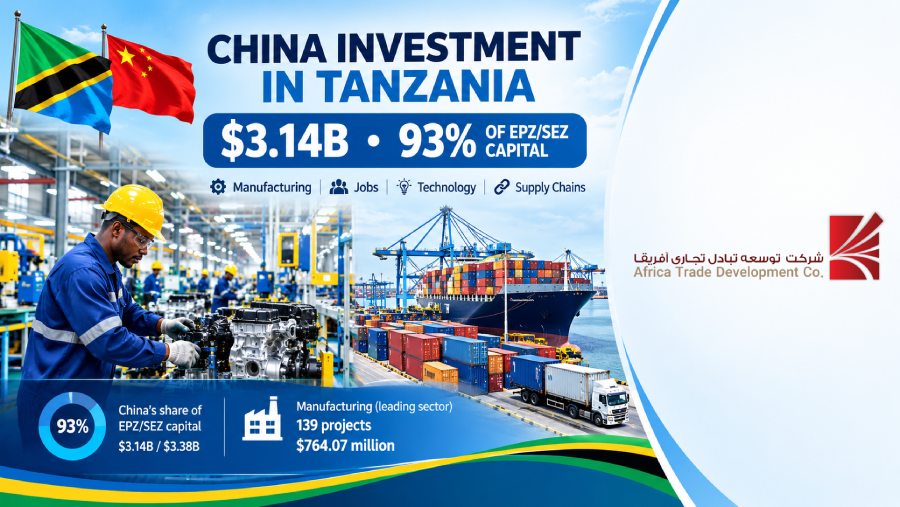
China is becoming an increasingly important source of investment in Tanzania, accounting for approximately $3.14 billion of the $3.38 billion in foreign capital registered under Tanzania’s EPZ and SEZ framework between April and June 2026.
The investment was associated with approximately 19,027 projected jobs, making China by far the largest source of foreign investment under the schemes during the quarter.
The figures come as manufacturing emerges as Tanzania’s leading investment destination, highlighting the country’s growing ambition to strengthen industrial production and value addition.
China Dominates Tanzania’s EPZ and SEZ Investment
According to data from the Tanzania Investment and Special Economic Zones Authority (TISEZA), seven projects registered under the EPZ/SEZ framework between April and June 2026 attracted approximately $3.38 billion in capital.
The projects are expected to generate:
- 30,235 jobs
- $517.8 million in projected export turnover
- $3.38 billion in total capital investment
China accounted for approximately $3.1438 billion, or about 93 percent, of the capital registered under the framework. Chinese-backed projects are projected to create 19,027 jobs and generate approximately $290.6 million in export turnover.
These figures refer to registered projects and projected outcomes rather than capital already fully deployed or jobs already created.
Manufacturing Becomes Tanzania’s Leading Investment Sector
China’s growing investment presence coincides with strong activity in Tanzania’s manufacturing sector.
During April–June 2026, Tanzania registered 243 projects under the general investment scheme, representing approximately $1.88 billion in capital and potential employment of 33,805 people.
Manufacturing accounted for:
- 139 projects
- $764.07 million in capital
- 17,875 projected jobs
Commercial buildings, construction and economic infrastructure followed with 13 projects worth $387.22 million, while tourism attracted 23 projects valued at $361.36 million. Agriculture recorded 23 projects worth $69.27 million.
Tanzania Seeks More Value from Chinese Investment
The growing scale of Chinese investment raises a broader question for Tanzania: How can the country transform foreign capital into stronger domestic industries, jobs, skills and businesses?
Experts quoted by The Citizen argue that Tanzania should focus on ensuring that foreign investment generates greater domestic value addition rather than simply increasing the volume of raw materials or low-value products exported.
Professor Humphrey Moshi of the University of Dar es Salaam’s Centre for Chinese Studies said Tanzania should use Chinese investment to strengthen industrialisation and increase the value of its exports.
Building Industrial Linkages
One important strategy is to create stronger connections between industries.
A factory producing intermediate goods could supply another Tanzanian factory, creating a network of interconnected industries.
Such industrial linkages can generate opportunities for:
- Local manufacturers
- Raw-material suppliers
- Logistics companies
- Packaging businesses
- Engineering firms
- Maintenance companies
- Technology providers
- Tanzanian SMEs
This would allow major foreign investments to generate economic activity well beyond their own operations.
Skills and Technology Transfer
Another major priority is technology and skills transfer.
Experts argue that Tanzania needs mechanisms to ensure that local workers gain technical and managerial capabilities when foreign companies establish manufacturing operations.
This could strengthen Tanzania’s human capital and increase the long-term benefits of foreign direct investment.
In this context, investment performance should not be measured only by capital inflows, but also by:
Capital + Technology + Skills + Jobs + Local Production + Exports
Opportunities for Tanzanian SMEs
Chinese manufacturing investment could also create new opportunities for Tanzanian small and medium-sized enterprises.
Local companies could potentially become suppliers of:
- Industrial components
- Packaging
- Raw materials
- Transport services
- Maintenance
- Engineering services
- Logistics
- IT and technology services
According to experts cited by The Citizen, stronger participation of Tanzanian businesses in foreign-invested supply chains could broaden the economic impact of Chinese investment and help local companies develop the capacity to compete in regional and international markets.
Tanzania’s Wider Investment Pipeline
The scale of the opportunity extends beyond Chinese investment.
Between April and June 2026, TISEZA registered 250 new investment projects across the general and EPZ/SEZ schemes.
This brought the cumulative number of registered projects to 934, with a total value of approximately $8.8 billion and potential to create more than 253,512 jobs.
Again, these figures represent registered investments and projected outcomes rather than fully deployed capital or jobs already created.
What Tanzania Needs to Maximise the Benefits
Experts argue that Tanzania needs a deliberate strategy for engaging China.
The priorities include:
- Increasing domestic value addition
- Developing local suppliers
- Expanding technology transfer
- Strengthening technical skills
- Connecting SMEs to industrial supply chains
- Increasing manufactured exports
- Improving investment negotiation capacity
- Developing stronger regional and international market connections
Professor Moshi also highlighted the importance of using platforms such as the Forum on China-Africa Cooperation (FOCAC) and the Belt and Road Initiative (BRI) to pursue opportunities in infrastructure, trade, industrialisation and connectivity.
Opportunities for Iranian Companies
The expansion of Tanzania’s industrial investment pipeline could also create opportunities for Iranian manufacturers and exporters.
Potential areas include:
- Industrial machinery
- Factory equipment
- Chemicals
- Petrochemical products
- Packaging equipment
- Agricultural machinery
- Construction materials
- Industrial components
- Engineering services
- Production technologies
For Iranian companies, the opportunity is not limited to selling finished products. The expansion of industrial projects could create demand for suppliers participating in industrial supply chains and B2B partnerships.
This makes Tanzania increasingly relevant not only as a consumer market, but also as a potential manufacturing and regional distribution platform for East Africa.
Conclusion
China accounted for approximately $3.14 billion, or 93 percent, of the $3.38 billion in foreign capital registered under Tanzania’s EPZ/SEZ framework during April–June 2026.
At the same time, manufacturing emerged as the leading sector under Tanzania’s wider investment scheme, with 139 projects worth $764.07 million and 17,875 projected jobs.
The next challenge for Tanzania is therefore not simply attracting more capital. It is converting foreign investment into local production, value addition, technology transfer, skilled employment and stronger domestic businesses.
If successful, Tanzania could move from simply hosting foreign-invested projects toward building a deeper and more connected industrial ecosystem serving both Tanzania and the wider East African market.
