

Blog
Tanzania’s Official Mineral Sales Reach TZS 6.85 Trillion as Gold Accounts for Over 97%

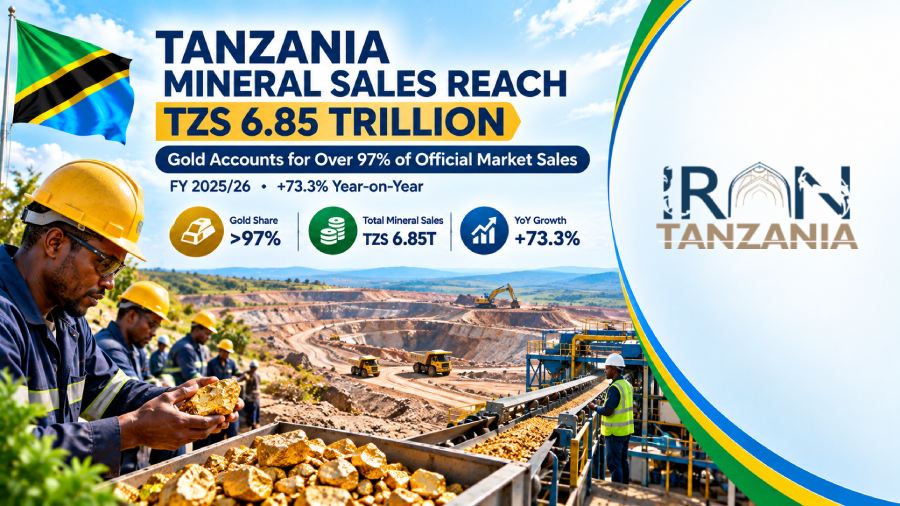
1. Official Mineral Sales Record Strong Growth
According to The Guardian, mineral sales through Tanzania’s official market centres reached approximately TZS 6,852 billion in 2025/26, compared with a revised TZS 3,954 billion in 2024/25.
Sales had stood at approximately TZS 2,464 billion in 2023/24. This means the value recorded through official mineral markets more than doubled over two years.
These figures refer specifically to transactions recorded through official mineral market centres. They should not be interpreted as the total value of mineral production, all mineral exports or government revenue from mining.
2. Gold Drives the Increase in Mineral Transactions
Gold sales reached approximately TZS 6,714 billion in 2025/26, an increase of around 75% compared with the previous year. Gold represented more than 97% of the total value of mineral sales recorded through official centres.
The figures underline the central role of gold in Tanzania’s formal mineral trade. The increase may reflect a combination of stronger gold prices, higher transaction values and the formalisation of mineral trading activities.
3. How Other Minerals Performed
Although gold dominated the market, other minerals also contributed to official sales during 2025/26:
-
Tin: Approximately TZS 30.8 billion.
-
Diamonds: Approximately TZS 10.6 billion.
-
Tanzanite: Approximately TZS 9.3 billion.
-
Other coloured gemstones: Approximately TZS 87.5 billion.
Tanzanite sales were lower than the approximately TZS 21.8 billion recorded in 2023/24, highlighting differences in performance across mineral categories.
4. Why Official Mineral Markets Matter
Official mineral markets provide regulated channels for buying and selling minerals. These channels can improve transaction transparency, strengthen oversight and help formalise commercial activity across the mining sector.
The growth in recorded sales also highlights the importance of gold to Tanzania’s mineral trade and foreign-exchange activity. However, a full assessment of the sector’s economic impact requires additional indicators, including physical production, export volumes, international prices and government royalties.
5. Potential Business Opportunities for Iranian Companies
The expansion of Tanzania’s mineral trade may create opportunities for businesses supplying mining and industrial equipment. Areas worth investigating include:
-
Mining machinery and equipment.
-
Industrial pumps, spare parts and material-handling systems.
-
Mineral processing, crushing and separation equipment.
-
Equipment maintenance and technical services.
-
Logistics and industrial support services for mining operations.
These are potential areas for market research rather than confirmed contracts or guaranteed demand. Iranian companies should verify local licensing rules, import requirements, technical standards and prospective buyers before pursuing commercial opportunities.
Conclusion
Tanzania’s official mineral sales reached approximately TZS 6.85 trillion in 2025/26, with gold accounting for more than 97% of the recorded total. The increase highlights the growing value of formal mineral trading and gold’s dominant position in Tanzania’s mining economy.
For Iranian businesses, this trend provides a reason to assess opportunities in mining equipment, processing technology and related industrial services in Tanzania.
The Iran–Africa Business Center can help companies research African markets, identify potential business partners and develop B2B connections.
Source: The Guardian – Tanzania mineral sales surge to record 6.8trn
