

East African Countries Cooperate to Address 1.2 Million-Tonne Sugar Deficit and Strengthen Regional Industry

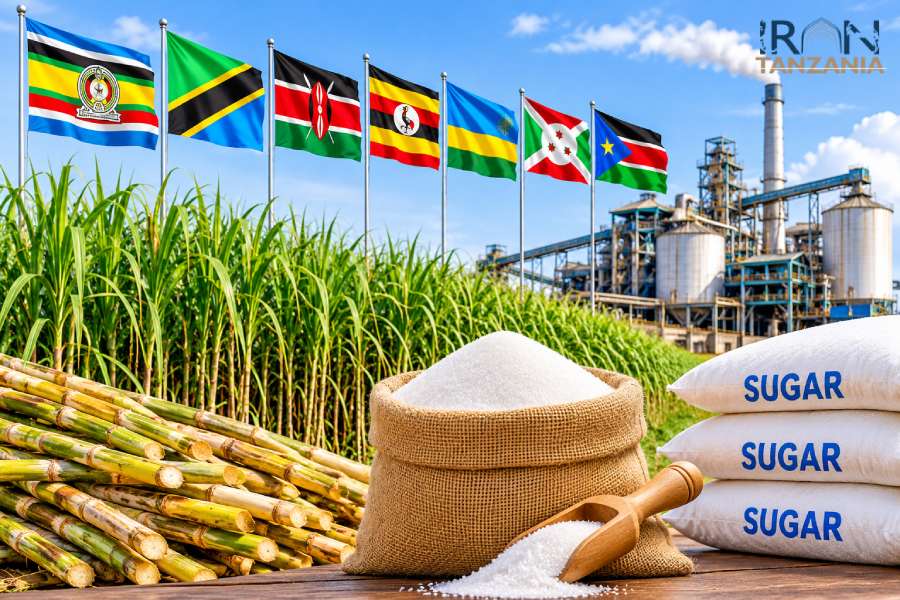
East African Community (EAC) countries are seeking to strengthen regional cooperation to increase domestic sugar production, expand intra-regional trade and reduce dependence on imports from outside the region.
According to data from the International Sugar Organisation (ISO), six EAC countries—Tanzania, Kenya, Uganda, Rwanda, Burundi and South Sudan—produced a combined 1.6 million tonnes of sugar in 2025, compared with estimated annual demand of 2.8 million tonnes.
This represents a supply deficit of approximately 1.2 million tonnes, highlighting the need for greater investment in domestic production and processing capacity across the region.
The issue was discussed following a board meeting of the East African Sugar Industry Association (EASIA) in Arusha, where industry representatives emphasised the importance of sharing technology, research and technical expertise to improve productivity.
Sugar Production and Consumption Across East Africa
Available figures show significant differences in sugar production and consumption among regional countries.
Tanzania: The country produced approximately 453,383 tonnes of sugar during the 2024/25 season, against estimated annual demand of 650,000 tonnes, resulting in a shortfall of around 196,617 tonnes.
Kenya: Sugar production reached approximately 815,500 tonnes in 2024, compared with estimated demand of 1.14 million tonnes in 2025, leaving a deficit of about 324,500 tonnes.
Uganda: The country produces between 650,000 and 700,000 tonnes annually, while domestic consumption stands at around 450,000 tonnes. This creates a potential surplus of 200,000 to 250,000 tonnes.
Rwanda: Annual sugar production is estimated at between 12,000 and 13,000 tonnes, meeting only approximately 7.5 percent of domestic demand.
These differences suggest that stronger regional trade could help redistribute sugar from surplus-producing countries to markets facing shortages. However, this will depend on addressing trade barriers, improving regulatory coordination and strengthening transport infrastructure.
Regional Cooperation to Increase Production and Reduce Imports
Professor Kenneth Benges, the newly elected chairman of EASIA and Director General of the Tanzania Sugar Board, has emphasised the importance of sharing experience, research findings and technologies among East African countries.
According to Benges, closer cooperation could increase production, create employment and reduce foreign exchange expenditure on sugar imports from outside the region.
Competition from major global producers, particularly Brazil and India, also makes improvements in technology, productivity and production costs increasingly important for East African manufacturers.
Key areas of cooperation include:
- Sharing technical knowledge and improved sugarcane cultivation technologies.
- Developing irrigation systems and increasing farm productivity.
- Improving the performance of sugar manufacturing and refining facilities.
- Investing in additional processing capacity.
- Expanding sugar trade between regional markets.
- Diversifying sugarcane-based products to generate additional value.
Beyond Sugar: Electricity, Ethanol and Fertiliser Production
One important opportunity for the East African sugar industry lies in making better use of by-products generated during sugarcane processing.
Bagasse, the fibrous residue left after extracting juice from sugarcane, can be used to generate electricity. Some regional sugar factories are increasingly using this resource to supply part of their own energy requirements and reduce reliance on national electricity grids.
In Uganda, one sugar factory has a power generation capacity of 50MW. Around 20MW is used for its own operations, while the remaining 30MW is supplied to the national electricity grid.
Sugar producers are also exploring opportunities to manufacture ethanol and fertiliser from sugarcane by-products.
These activities can reduce industrial waste, improve operational efficiency and create additional revenue streams for sugar manufacturers.
Tanzania Assumes EASIA Chairmanship
During the latest EASIA board meeting, Tanzania assumed the association’s chairmanship for the next two years.
Under the new leadership arrangement, Kenya took the vice-chairmanship, while Uganda assumed responsibility for the association’s secretariat.
Through its links with the East African Business Council (EABC), EASIA also communicates industry recommendations to ministries responsible for agriculture, trade and finance in member countries.
The objective is to improve the regional business environment and encourage investment in the sugar sector.
Business Opportunities for Iranian Companies
The sugar supply deficit and regional plans to expand production could create opportunities for Iranian companies operating in food processing, agriculture and industrial machinery.
Potential areas of cooperation include:
1. Sugar factory machinery: Supplying equipment for sugarcane crushing, juice extraction, purification, crystallisation and packaging.
2. Agricultural and irrigation equipment: Providing sugarcane cultivation and harvesting machinery, irrigation systems and farm productivity technologies.
3. Industrial supplies: Supplying spare parts, maintenance equipment and industrial materials required by sugar factories.
4. Sugarcane by-product industries: Supporting projects involving electricity generation from bagasse, ethanol production and fertiliser manufacturing.
5. Investment and technology transfer: Partnering with regional manufacturers and investors to expand production and processing capacity.
6. Sugar trade and exports: Exploring supply opportunities in deficit markets, subject to import permits, tariffs and applicable regional trade regulations.
For Iranian companies, the opportunities are not limited to sugar exports. Machinery, engineering services and technology transfer could also provide a basis for longer-term commercial cooperation.
Conclusion
The approximately 1.2 million-tonne sugar deficit across East Africa highlights the need to expand production capacity and strengthen regional trade.
Cooperation in technology sharing, agricultural productivity, processing facilities and sugarcane by-product utilisation could reduce the region’s dependence on external imports while creating new economic opportunities.
For Iranian companies active in food processing, agricultural machinery, industrial equipment and manufacturing technologies, the development of East Africa’s sugar industry offers potential opportunities to explore exports and investment partnerships in the region.
Sources:
- The Citizen Tanzania, “East African Community Nations Join Forces to Close 1.2 Million-Tonne Sugar Deficit,” November 15, 2026.
- The EastAfrican, “EAC Sugar Producers Seek Regional Cooperation to Close 1.2m-Tonne Supply Gap,” November 16, 2026.
- International Sugar Organisation (ISO), regional sugar production and demand figures as reported in the cited coverage.
- East African Sugar Industry Association (EASIA), Arusha board meeting information.
