

Tanzania’s Aquaculture Production Rises 261% as Government Seeks New Investors

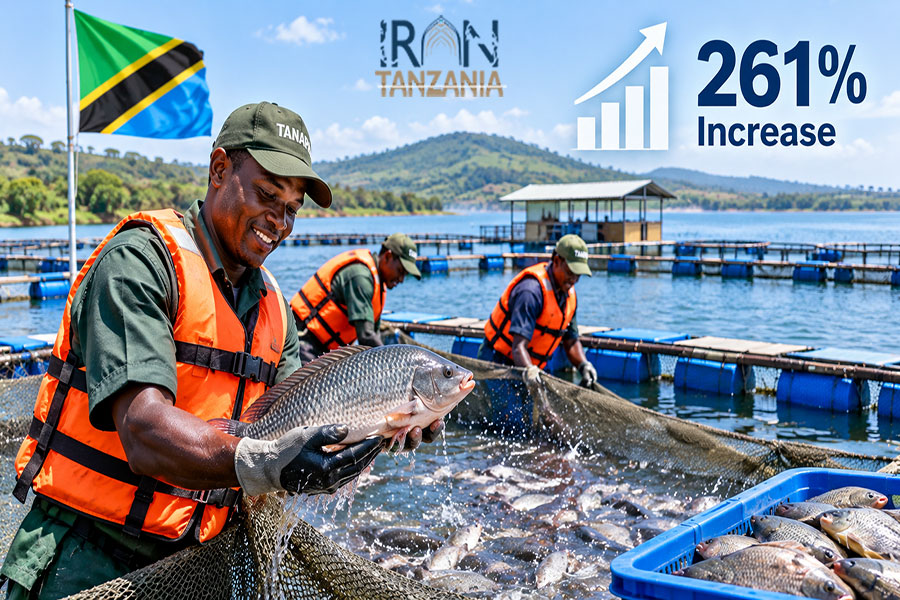
Tanzania’s aquaculture industry has recorded significant growth over the past four years, prompting the government to seek new investors, advanced technologies and stronger commercial partnerships.
According to figures announced by the Minister for Livestock and Fisheries, aquaculture production, including farmed fish and seaweed, increased from approximately 64,930 tonnes in the 2021/22 financial year to 234,524 tonnes in 2025/26, representing growth of around 261.2%.
Aquaculture Production and Economic Value Increase
The value of aquaculture production also increased from TZS 187.3 billion in 2021/22 to TZS 446.8 billion in 2025/26.
The expansion has been accompanied by improvements in production infrastructure:
- Fish cages increased from 780 to 3,343.
- Hatcheries increased from 35 to 67.
- Fingerling production rose from 31.4 million to 212.8 million.
- The number of aquaculture farmers increased from 31,998 to 53,992.
Farmed fish now accounts for 10.13% of Tanzania’s total fish production, compared with approximately 5% previously.
Government Seeks Investment and Advanced Technology
The Ministry of Livestock and Fisheries is encouraging greater private-sector participation to sustain the industry’s growth.
Key priorities include:
- Expanding commercial fish farming in ponds and floating cages.
- Improving access to quality fingerlings and fish breeding technologies.
- Increasing domestic production of affordable fish feed.
- Strengthening research, training and technical advisory services.
- Identifying suitable locations for cage fish farming.
- Improving access to concessional financing.
- Strengthening fish health standards and environmental protection.
The government’s objective is to develop a more integrated aquaculture value chain, from input supply and fish farming to processing and marketing.
TZS 29.98 Billion in Financing Support
The government has facilitated access to financing worth TZS 29.98 billion to support aquaculture and fisheries-related activities.
The announced allocations and commitments include:
- TZS 13.6 billion for community groups and producers.
- TZS 7 billion for young graduates under the Building Better Tomorrow (BBT) Fisheries Programme.
- TZS 9.38 billion pledged to support youth-led start-ups.
The financing covers activities such as cage fish farming, sea cucumber farming, crab fattening and seaweed production.
International Aquaculture Conferences in Dar es Salaam
Tanzania is preparing to host two major international events to showcase its aquaculture potential and attract global partners:
- World Aquaculture Tanzania 2026
- African Aquaculture Conference 2026
The events will take place from December 1 to 4, 2026, at the Julius Nyerere International Convention Centre in Dar es Salaam.
More than 1,000 participants from over 100 countries are expected to attend, including investors, fish farmers, technology providers, researchers, universities and financial institutions.
The conferences will provide opportunities for business networking, technology exhibitions, technical discussions and investment partnerships.
Business Opportunities for Iranian Companies
Tanzania’s expanding aquaculture industry could create opportunities for Iranian companies operating in food processing, agricultural machinery, fisheries and industrial equipment.
Potential areas include:
- Fish farming equipment: Floating cages, ponds, pumps, aeration systems and water-quality monitoring equipment.
- Fish feed production: Feed-processing machinery, mixing and pelletising lines, raw materials and additives.
- Hatchery technology: Hatchery equipment, breeding systems and fingerling production technologies.
- Seafood processing: Cleaning, filleting, packaging, freezing and cold-storage equipment.
- Technical services: Farm design, equipment installation, workforce training and production management.
Iranian companies can explore export opportunities and potential joint ventures by identifying local producers, distributors and investment partners.
Conclusion
The 261.2% increase in Tanzania’s aquaculture production between 2021/22 and 2025/26 highlights the growing importance of this sector in the country’s food system and economy.
Government efforts to attract investors, expand hatcheries, improve fish-feed production and promote international cooperation could create opportunities throughout the aquaculture value chain.
For Iranian businesses, fish-farming equipment, feed production technology, hatchery systems and seafood-processing machinery are among the areas worth exploring in the Tanzanian market.
Sources: The Guardian Tanzania, The Respondent and Tanzania’s Ministry of Livestock and Fisheries.
