

Tanzania Develops New Strategy to Strengthen Financial Stability and Finance Carbon Projects

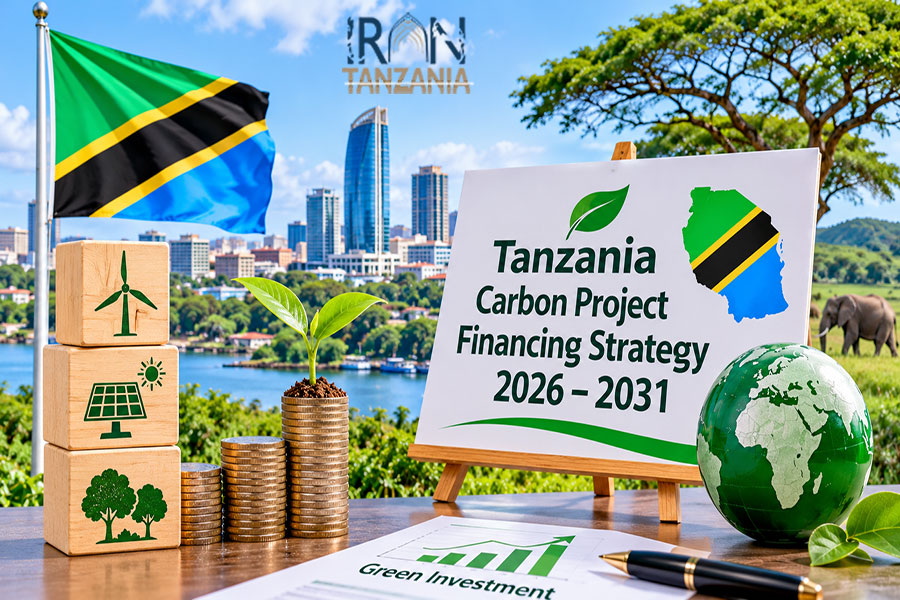
Tanzania is strengthening coordination among financial regulators and developing new mechanisms to finance carbon projects. At the 14th meeting of the Tanzania Financial Stability Forum, authorities reviewed the country’s financial stability outlook and approved the National Carbon Project Financing Strategy for 2026–2031.
The meeting was chaired by Emmanuel Tutuba, Governor of the Bank of Tanzania. Discussions covered the Financial Stability Report for the six months ending June 2026, guidelines for financial crisis simulation exercises and the new carbon project financing strategy.
National Carbon Project Financing Strategy 2026–2031
One of the key outcomes was the approval of the National Carbon Project Financing Strategy for the five-year period from 2026 to 2031.
The strategy aims to improve access to finance for carbon project developers and strengthen Tanzania’s participation in regional and international carbon markets.
Carbon projects often require substantial upfront investment. Feasibility studies, technical documentation, validation, verification and emissions monitoring can create significant financial barriers for project developers.
The new strategy seeks to address these challenges and strengthen connections between financial institutions and carbon project developers.
Coordination Among 15 Financial Institutions
The Tanzania Financial Stability Forum brings together 15 institutions responsible for regulating and supervising different parts of the country’s financial system.
Its members include the Bank of Tanzania, the Ministry of Finance, Zanzibar’s Ministry of Finance and Planning, the Tanzania Insurance Regulatory Authority, the Capital Markets and Securities Authority and the Financial Intelligence Unit.
The forum provides a platform for coordinating financial supervision, identifying emerging risks and strengthening the country’s preparedness for potential economic and financial shocks.
During the latest meeting, participants also discussed financial crisis preparedness and measures to combat money laundering and illicit financing.
CRDB Bank and National Carbon Monitoring Centre Partnership
Another important development is a five-year partnership between CRDB Bank and Tanzania’s National Carbon Monitoring Centre (NCMC), signed on November 13, 2026, on the sidelines of COP31 in Antalya, Türkiye.
The partnership aims to improve access to domestic financing for eligible carbon projects.
Potential financial instruments include:
- Bank loans for carbon project developers.
- Guarantees and investment risk-mitigation instruments.
- Financial products designed for green projects.
- Assessment and financing of projects under applicable banking and regulatory requirements.
The NCMC provides technical and monitoring expertise related to greenhouse gas emissions and Tanzania’s carbon market framework. Its cooperation with CRDB is intended to connect project assessment with domestic financing.
Which Projects Could Benefit from Carbon Finance?
Tanzania has several natural and economic assets that could support the development of carbon projects, including forests, mangroves, renewable energy and emissions-reduction initiatives in transport and infrastructure.
Potential areas include:
1. Forest Conservation and Restoration
Forest protection, restoration and sustainable natural resource management can support projects that generate carbon credits.
2. Mangrove and Coastal Ecosystem Protection
Mangrove conservation and restoration offer opportunities for blue carbon projects, alongside wider environmental benefits.
3. Renewable and Clean Energy
Solar and wind energy projects, as well as energy-efficiency initiatives, can reduce greenhouse gas emissions and potentially qualify for carbon-market mechanisms.
4. Transport and Urban Infrastructure
Projects such as the Standard Gauge Railway (SGR), Dar es Salaam Rapid Transit (DART) and the Julius Nyerere Hydropower Project have also been identified for assessment of potential carbon-market opportunities.
Business and Investment Opportunities for Iranian Companies
The development of Tanzania’s carbon market could create opportunities for Iranian businesses operating in environmental services, renewable energy, technology and financial consulting.
Potential areas include:
- Clean energy: Solar power projects, energy-saving equipment and energy-efficiency solutions.
- Forest projects: Technical services for restoration, monitoring and sustainable forest management.
- Carbon monitoring technology: Emissions measurement equipment, data collection systems and environmental reporting software.
- Consulting and validation: Feasibility studies, project documentation and carbon-market standards support.
- Infrastructure and waste management: Emissions-reduction projects in transport, waste management and wastewater treatment.
Companies entering this market should understand Tanzania’s carbon regulations, crediting standards and monitoring, reporting and verification requirements. Each project also requires independent assessment of its financial and environmental integrity.
Conclusion
The approval of Tanzania’s National Carbon Project Financing Strategy for 2026–2031 represents an effort to turn the country’s environmental resources into investment and economic opportunities.
Coordination among 15 financial institutions, the CRDB–NCMC partnership and the development of financial instruments such as loans and guarantees could help address financing barriers for eligible carbon projects.
For Iranian companies, renewable energy, emissions-monitoring technology, forest conservation and carbon-market technical services are among the areas worth exploring in Tanzania’s growing green economy.
Sources: The Respondent, Bank of Tanzania and Shore Africa.
