



What Does the $7.9 Million Lupita Island Deal Really Mean?
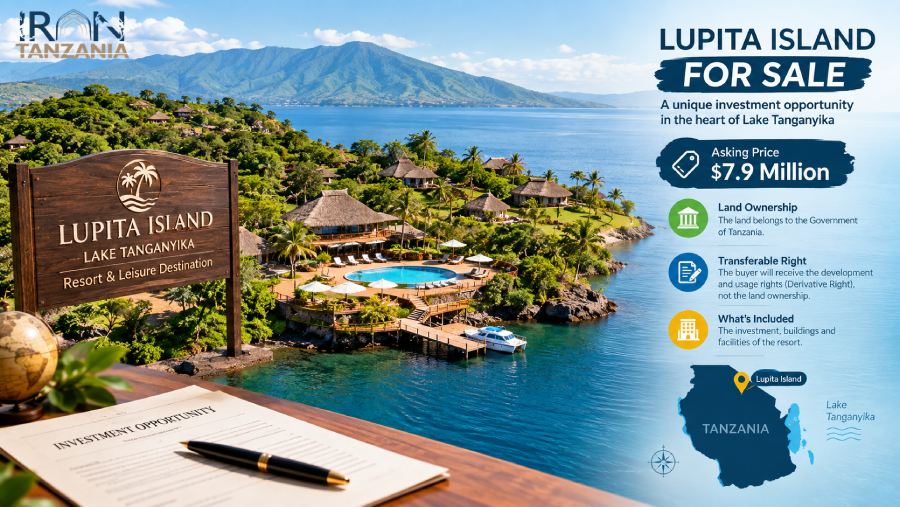
The proposed sale of Lupita Island, a luxury resort located on Lake Tanganyika in Tanzania, has attracted international attention after American investor Tim Draper announced an asking price of approximately $7.9 million.
However, the story contains an important legal detail for foreign investors: the land itself is not privately owned by the investor.
Tanzania’s Ministry of Lands clarified that Lupita Island remains under state ownership. Firelight Safaris Ltd., in which Tim Draper is a shareholder, holds a Derivative Right allowing the company to develop and operate the tourism project on the island.
This raises an important question for international investors:
Can foreigners buy land in Tanzania?
The Short Answer: Direct Land Ownership Is Restricted
Tanzania’s land framework treats land as public land, while foreign investors can access land for approved investment purposes through specific legal structures.
According to the Tanzania Investment and Special Economic Zones Authority (TISEZA), foreign investors can obtain land for investment purposes through a Derivative Right. Long-term lease arrangements may also be available depending on the structure of the investment.
This means investors need to distinguish between:
Land ownership
and
the legal right to use, develop and operate a project on the land.
That distinction is critical when evaluating investment opportunities in Tanzania.
What Is a Derivative Right?
A Derivative Right can be broadly understood as a legally recognized right allowing an investor to use and develop land for an approved investment project.
The investor does not necessarily acquire the underlying land as private property. Instead, the investor receives a legally structured right to use the land for the purposes defined by the investment arrangement.
TISEZA states that foreign investors may access land through Derivative Rights and long-term lease structures. These rights may be granted for long periods, potentially up to 99 years under the applicable framework.
This structure allows Tanzania to retain the public character of land while enabling foreign capital to develop commercial and industrial projects.
So What Is Actually Being Sold in the Lupita Island Case?
This is where the Lupita Island story becomes particularly relevant.
According to the Tanzanian government’s clarification, the island itself is not being sold as privately owned land.
Instead, the investment being offered may involve the resort development, buildings, facilities and the investor’s legally transferable interests connected with the project.
Reports on the transaction have emphasized that Firelight Safaris holds the Derivative Right to develop and operate the tourism project. Therefore, transferring the investment does not mean transferring ownership of the land beneath it.
In other words, describing the transaction simply as the “sale of a $7.9 million private island” can create a misleading impression.
A more accurate description is:
A tourism investment and resort development on Lupita Island has been offered for approximately $7.9 million, while the underlying land remains under state ownership.
Why Does This Matter to Iranian Investors?
This distinction is highly relevant to Iranian companies and investors considering Tanzania.
A foreign investor should not evaluate a property simply by asking:
“Who owns the land?”
The more important questions are:
- What legal right is being transferred?
- Is there a Derivative Right?
- Is there a long-term lease?
- Are the buildings and infrastructure included?
- Are the operating licenses included?
- Is a company being sold instead of the underlying property?
- Can the investment rights legally be transferred?
- Are there mortgages, debts or other encumbrances?
These questions are particularly important for hotels, tourism projects, factories, agricultural projects, warehouses, logistics facilities and industrial developments.
Can Foreign Investors Obtain Land for Their Projects?
Yes, but the structure is different from simply purchasing private land as an individual.
TISEZA’s official land-acquisition procedures allow foreign investors to apply for land for investment purposes and obtain a Derivative Right after the relevant legal and administrative procedures are completed. The process includes land identification, allocation, registration and issuance of the relevant rights and leasehold documentation.
Long-term lease structures can also be used in certain circumstances.
Therefore:
Restrictions on direct land ownership do not mean that foreign investors cannot develop projects on land in Tanzania.
They mean that the legal structure of land use and investment must be properly established.
An Important Point About Financing
Another important feature of the Derivative Right framework is its potential role in project financing.
TISEZA states that an investor may mortgage property held under a Derivative Right, subject to obtaining the required consent.
This can be significant for larger projects because the investor may be able to structure financing around its legally recognized rights in the project and the associated assets.
What Can Iranian Investors Learn from Lupita Island?
The Lupita Island case demonstrates an important principle:
The value of an investment project is not necessarily the same as ownership of the underlying land.
A project can involve substantial investment in buildings, equipment, infrastructure, licenses, operations and commercial assets while the underlying land remains publicly owned.
For this reason, investors should ask:
What exactly is being transferred in the transaction?
rather than simply:
“Is the land being sold?”
This distinction can prevent significant legal and financial risks.
Potential Opportunities for Iranian Investors
Tanzania’s land framework does not necessarily prevent foreign investment. Instead, it highlights the importance of choosing the correct investment structure.
Potential areas for Iranian companies and investors include:
- Tourism and hospitality
- Food processing
- Agro-processing
- Manufacturing
- Warehousing and logistics
- Industrial projects
- Energy and equipment
- Commercial agriculture
- Engineering and construction services
For these projects, legal and commercial due diligence should examine the land structure, duration and conditions of the Derivative Right, transferability, permits, liabilities, leases and ownership of buildings and equipment.
Conclusion
The proposed $7.9 million Lupita Island transaction is more than an unusual tourism story. It provides an important lesson for anyone considering investment in Tanzania.
Foreign investors can access land in Tanzania for investment purposes through legal structures such as Derivative Rights and long-term leases, but this is not the same as unrestricted private ownership of the land itself.
For foreign investors, the key question is therefore not simply:
“Can I buy land in Tanzania?”
The better question is:
“What legal right will I receive, how long will it last, can it be transferred or used as collateral, and exactly which assets are included in the investment?”
For a major investment, that distinction can be worth millions of dollars.
