

Tanzania’s 10 Largest Regional Economies in 2025: Dar es Salaam Leads

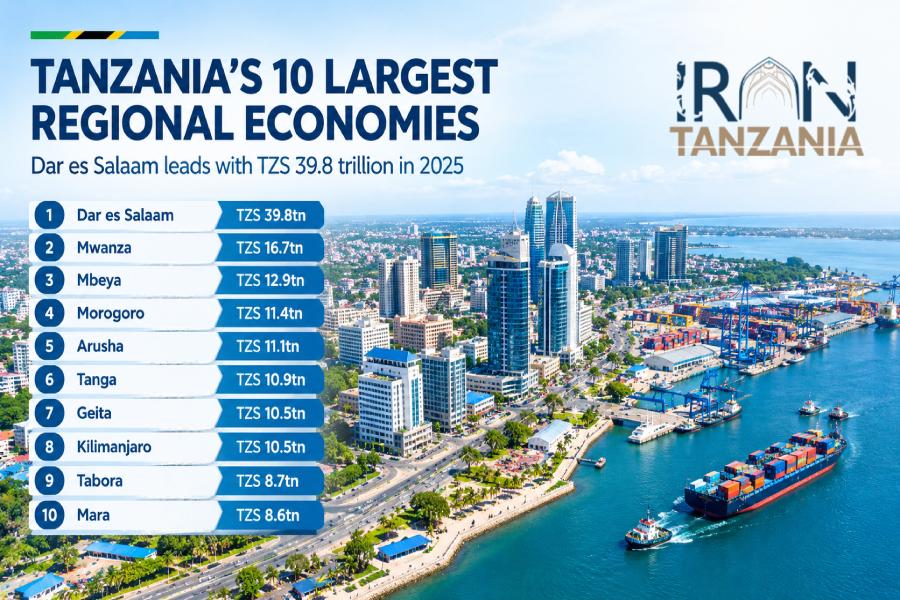
Dar es Salaam was Tanzania Mainland’s largest regional economy in 2025, recording a gross regional product (GRP) of approximately TZS 39.8 trillion. This was more than twice the output recorded by Mwanza, the country’s second-largest regional economy.
The figures were reported by Tanzanian newspaper The Citizen on October 20, 2026, and are consistent with the national accounts statistics published by Tanzania’s National Bureau of Statistics.
The ranking provides a useful overview of where economic activity is concentrated across Tanzania. For Iranian companies considering exports, local distribution or commercial partnerships, it can serve as an initial guide to regional market research.
Tanzania’s 10 Largest Regional Economies
The following ranking presents the ten largest regional economies in 2025. Figures are rounded and expressed in trillion Tanzanian shillings.
| Rank | Region | Gross Regional Product |
|---|---|---|
| 1 | Dar es Salaam | TZS 39.8 trillion |
| 2 | Mwanza | TZS 16.7 trillion |
| 3 | Mbeya | TZS 12.9 trillion |
| 4 | Morogoro | TZS 11.4 trillion |
| 5 | Arusha | TZS 11.1 trillion |
| 6 | Tanga | TZS 10.9 trillion |
| 7 | Geita | TZS 10.5 trillion |
| 8 | Kilimanjaro | TZS 10.5 trillion |
| 9 | Tabora | TZS 8.7 trillion |
| 10 | Mara | TZS 8.6 trillion |
Small differences between published figures may result from rounding.
Why Dar es Salaam Leads Tanzania’s Regional Economy
Dar es Salaam is one of Tanzania’s principal commercial and economic centres. The concentration of trade, manufacturing, real estate, transport, accommodation and food services contributes to its significant share of national economic output.
Tanzania’s National Bureau of Statistics reports regional output for Dar es Salaam of approximately TZS 39.8 trillion in 2025, representing about 17% of mainland GDP. Mwanza contributed approximately TZS 16.7 trillion, or around 7.2%.
For international businesses, Dar es Salaam is also an important gateway for imports, distribution and access to commercial networks serving Tanzania and neighbouring markets.
However, a large regional economy does not automatically guarantee that every product will be commercially successful. Product demand, purchasing power, competition, logistics costs and import regulations must also be considered.
Potential Trade Opportunities Across Tanzania’s Regions
Regional economic differences can help companies develop more targeted market-entry strategies instead of treating the entire country as a single market.
Dar es Salaam: A Starting Point for Market Research and Distribution
Because of its concentration of commercial activity and services, Dar es Salaam may be a useful starting point for researching consumer goods, industrial inputs, equipment, packaging and business services.
Mwanza: A Major Market Around Lake Victoria
Located in northwestern Tanzania, Mwanza is an important commercial centre for the Lake Victoria area. Businesses can investigate its distribution networks and potential commercial customers as part of their market research.
Mbeya and Morogoro: Agriculture and Supply Chains
These regions may warrant research into agriculture, food processing, equipment and supply-chain services. Actual opportunities should be verified through product-specific data on production, demand and distribution.
Arusha and Kilimanjaro: Tourism and Related Services
Their tourism potential makes these regions relevant for researching hotel equipment, tourism services, digital solutions and selected food and consumer products.
Geita: Mining-Related Demand
Geita is an important mining region. Suppliers of industrial equipment, spare parts, machinery maintenance and technical services may investigate demand in this sector, subject to applicable procurement, standards and mining regulations.
These are potential areas for market research, not confirmed purchase orders or awarded contracts.
What the Ranking Means for Iranian Exporters
For Iranian companies, the ranking can help prioritise regional market research in Tanzania. Rather than investigating every region simultaneously, businesses can focus first on areas that fit their products and distribution models.
For example, a consumer-goods exporter may prioritise distribution networks in Dar es Salaam, while agricultural or mining equipment suppliers may need to identify specialist customers in other regions.
A practical market-entry process includes:
- Assessing demand for the product in Tanzania.
- Identifying importers, distributors and prospective buyers.
- Reviewing competitor prices, freight costs and import requirements.
- Selecting suitable regions for initial commercial discussions.
- Verifying partner credibility and payment terms before signing contracts.
The Iran–Africa Business Center can assist Iranian companies with Tanzania market research, buyer and partner identification, and the assessment of potential commercial cooperation.
GRP Does Not Measure Household Wealth
Gross regional product measures the value of economic activity generated in a region. It does not necessarily indicate individual income, household wealth or how income is distributed among residents.
Although Dar es Salaam has Tanzania’s largest regional economy, selecting a sales market still requires an understanding of target customers, purchasing power, demand and competition within each product category.
Conclusion
Dar es Salaam led Tanzania’s regional economies in 2025 with approximately TZS 39.8 trillion in output. Mwanza, Mbeya, Morogoro and Arusha were also among the country’s largest regional economies.
For Iranian companies, the ranking is best used as a starting point for market research. Export and investment decisions should be based on verified product demand, buyer access, costs and local regulations.
