

Tanzania Pushes Local Processing of Raw Materials, Technology Transfer and Job Creation

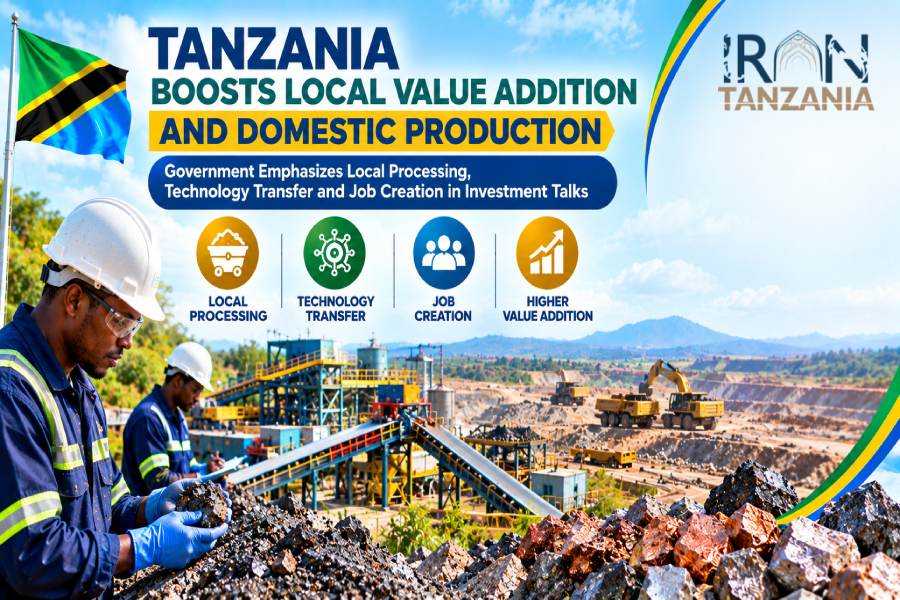
Tanzania is strengthening its efforts to capture more economic value from its natural resources by expanding domestic processing, industrial production and technical capabilities. In mining-related discussions with international partners, including Russia, Tanzanian officials have emphasised local mineral processing, modern technology transfer and the development of skilled local workers.
Reports published between 13 and 16 October 2026 highlight the government’s position that mining cooperation should extend beyond extracting and exporting raw materials. Instead, partnerships should support industrial development, employment and greater economic benefits for resource-producing countries. These priorities were raised during the Russia-Africa Raw Materials Dialogue in Saint Petersburg.
1. From raw mineral exports to higher-value production
Exporting unprocessed minerals can generate foreign exchange, but a significant share of a mineral’s potential economic value may be created in subsequent stages of the production chain, including crushing, separation, refining, smelting and the manufacture of semi-finished or finished products.
Tanzania wants to expand more of these activities domestically. Such a shift could support skilled employment, strengthen local suppliers and increase the participation of Tanzanian businesses in mining-related supply chains.
Under this approach, progress is not measured solely by extraction volumes. Domestic processing capacity, workforce development, sustainable employment and the participation of local companies also matter.
2. Tanzania–Russia mining cooperation focuses on technology and skills
During the Russia-Africa Raw Materials Dialogue, held in Saint Petersburg from 12 to 17 October 2026, Tanzania’s Deputy Minister for Minerals, Dr Steven Kiruswa, called for stronger mining cooperation with Russia.
According to Daily News Tanzania, the discussions focused on expanding mineral processing in producing countries, transferring modern technologies, training local workers and ensuring that resource-rich countries obtain measurable economic benefits. Kiruswa also acknowledged training opportunities in modern technologies and encouraged Russian companies to accelerate licensed mining projects in Tanzania.
The discussions underline the importance of technical knowledge and workforce development alongside capital investment.
3. Attracting foreign investment to strengthen domestic industry
Tanzania has recently stepped up efforts to attract foreign investors into mining, agriculture, processing and logistics.
During Tanzania–European Union business engagements in the Netherlands, Tanzanian officials encouraged investors to look beyond mineral extraction and raw-material exports. They highlighted opportunities in mineral processing, manufacturing and the development of domestic value chains.
A separate report published on 13 October also highlighted Tanzania’s ambition to attract more investment to accelerate industrialisation, expand the local processing of natural resources and create jobs for its growing young population.
For the government, the objective is not simply to attract foreign capital. It is also to translate investment into productive capacity, technical knowledge and stronger links between major projects and local businesses.
4. Which parts of the mineral value chain could expand?
Expanding domestic processing requires investment in several complementary areas. Opportunities will vary according to the mineral involved, existing infrastructure, energy availability and project financing.
Potential areas to examine include:
-
Mineral processing and separation: Crushing, screening, washing and mineral separation equipment.
-
Smelting and refining: Facilities that convert concentrates and raw materials into higher-purity metals and other products.
-
Industrial manufacturing: Using domestic minerals to produce steel, metal components and semi-finished products.
-
Mining machinery and equipment: Extraction machinery, material-handling systems, spare parts and maintenance.
-
Engineering and laboratory services: Mineral testing, process design, quality control and technical training.
-
Energy- and water-efficiency solutions: Technologies that improve resource use in mines and processing plants.
Each opportunity requires project-specific assessment. A policy encouraging value addition does not, by itself, confirm that a particular project or procurement tender is available.
5. Technology transfer and job creation as cooperation priorities
A central message from Tanzanian officials is that mining projects should deliver tangible benefits to the domestic economy. Technology transfer therefore involves more than importing machinery. It can also include training employees, developing local maintenance capabilities, improving processing methods and enabling Tanzanian suppliers to participate in mining supply chains.
Investors able to demonstrate credible plans for workforce training, local supplier development and productivity improvements may be well positioned to explore potential partnerships. Actual requirements, however, will depend on each project’s contracts, regulations and technical and financial conditions.
6. What the policy could mean for Iranian companies
Tanzania’s focus on domestic processing could provide a reason for Iranian mining, metals and industrial equipment companies to investigate the market.
Potential areas for market research include:
-
Supplying mineral-processing machinery and equipment.
-
Providing spare parts and industrial maintenance services.
-
Offering engineering services and production-line optimisation.
-
Supplying laboratory equipment and mineral-quality testing systems.
-
Exploring partnerships with local businesses in semi-finished and industrial products.
-
Providing technical training and knowledge-transfer services.
Before entering the market, companies should assess investment and import regulations, mining licence requirements, logistics costs, energy availability and project financing. Checking the credibility of potential local partners and the transparency of contractual arrangements is also essential.
7. Challenges facing domestic mineral processing
Expanding mineral-processing industries requires more than government policy or investor interest. Projects may need substantial upfront capital, reliable energy, transport infrastructure, specialised machinery and skilled workers.
Important considerations include:
-
Electricity and infrastructure costs.
-
Access to long-term financing.
-
Training and workforce development requirements.
-
Competitiveness of processed products in domestic and export markets.
-
Environmental compliance and mineral-waste management.
-
Effective links between foreign investors and local suppliers.
A sound feasibility assessment should therefore consider not only extraction costs, but also processing, energy, transportation, market access and environmental obligations.
Conclusion
Tanzania’s emphasis on local processing, technology transfer and job creation reflects its effort to retain more economic value from its natural resources. Mining discussions with Russia and investment outreach to European businesses indicate that the government is seeking partnerships that contribute to productive capacity, workforce skills and supporting industries—not capital alone.
For Iranian companies, this direction may create opportunities to investigate mining equipment, engineering services, processing technologies and industrial partnerships. Commercial decisions should nevertheless be based on specific projects, verified investment conditions and careful assessment of local partners.
Iran Tanzania — Connecting businesses with African markets
Businesses seeking to research Tanzania, identify potential buyers and partners, or explore B2B opportunities across Africa can consider the services of the Iran–Africa Business Center.
Frequently Asked Questions
1. Why is Tanzania promoting domestic processing of raw materials?
The aim is to increase local value addition, expand manufacturing, create jobs and retain a greater share of the economic benefits generated by natural resources.
2. What did Tanzania discuss with Russia?
Reports published in October 2026 highlighted domestic mineral processing, modern technology transfer, workforce training and stronger mining cooperation.
3. What opportunities could be relevant to Iranian companies?
Potential areas to investigate include mineral-processing equipment, mining machinery, industrial spare parts, engineering services, quality-control equipment and technical training.
4. Does the policy announcement guarantee investment opportunities?
No. It describes the government’s broader direction. Companies must verify specific projects, licences, procurement opportunities and investment conditions.
5. What determines the success of domestic mineral-processing projects?
Reliable energy and infrastructure, financing, suitable technology, skilled labour, market demand and environmental compliance are all important factors.
Sources
-
Daily News Tanzania — Tanzania and Russia focus on mineral value addition and technology transfer
-
The Citizen — Tanzania woos Dutch investors for mining, agriculture and logistics
-
The Chanzo — Tanzania drafts a five-year strategy to expand domestic mineral processing
-
Business Insider Tanzania — Tanzania’s investment ambitions focus on jobs and industrialisation
