



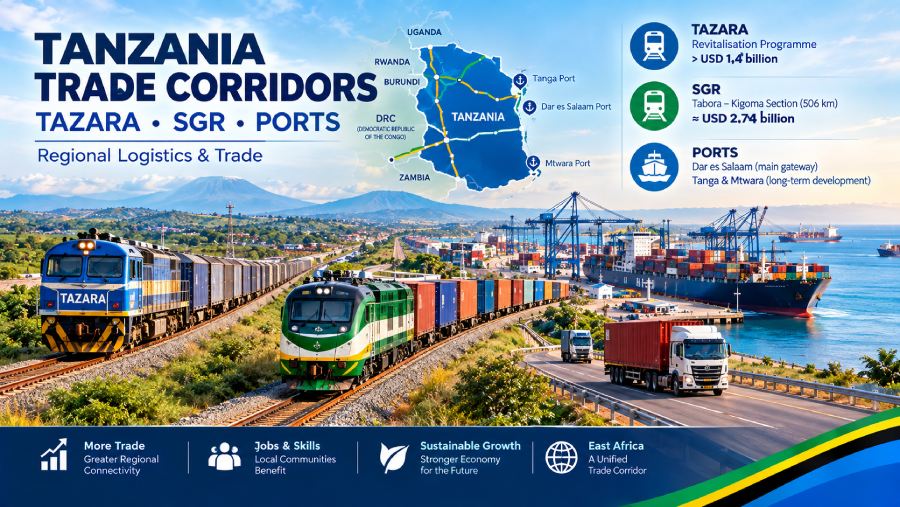
Tanzania is expanding an integrated transport network combining railways, ports and road corridors to strengthen its role in regional trade across East and Central Africa.
The revitalisation of the TAZARA railway, expansion of the Standard Gauge Railway (SGR) network and development of major ports such as Dar es Salaam, Tanga and Mtwara are important parts of this infrastructure strategy.
Tanzania’s geographical position on the Indian Ocean gives its transport infrastructure strategic importance for both domestic trade and landlocked neighbouring markets.
The country’s transport corridors connect or support trade with countries including Zambia, the Democratic Republic of Congo, Rwanda, Burundi, Uganda and Malawi.
More Than $1.4 Billion Investment in TAZARA
One of the most significant railway projects is the revitalisation of TAZARA.
According to TAZARA, Chinese company CCECC is expected to invest more than $1.4 billion in the railway’s revitalisation programme.
The programme includes:
- approximately $1 billion for track rehabilitation
- around $400 million for locomotives and wagons
- railway infrastructure upgrades
- operational improvements
- increased freight capacity
- improved service reliability
The TAZARA railway network covers approximately 1,800 kilometres, connecting Dar es Salaam with inland Tanzania and Zambia.
The revitalisation programme is expected to improve the railway’s ability to handle regional freight and potentially shift part of cargo transportation from roads to rail.
TAZARA and Regional Trade
TAZARA’s strategic importance comes from its connection between the Port of Dar es Salaam and inland markets.
For landlocked countries such as Zambia, reliable access to an Indian Ocean port is important for international trade.
Improved TAZARA capacity could create opportunities across:
- freight transportation
- logistics
- warehousing
- transit services
- supply-chain management
- railway equipment
- engineering
- maintenance services
This makes railway infrastructure relevant not only to transport companies but also to industrial suppliers and service providers.
Tanzania’s SGR Railway Expansion
The second major pillar of Tanzania’s railway strategy is the Standard Gauge Railway (SGR).
The SGR network is being developed to provide a modern railway system connecting Dar es Salaam with different regions of Tanzania and, ultimately, regional markets.
Major sections include routes such as:
- Dar es Salaam–Morogoro
- Morogoro–Makutopora
- Makutopora–Tabora
- Tabora–Isaka
- Isaka–Mwanza
The network is intended to improve connections between ports, production centres, agricultural areas and regional markets.
$2.74 Billion Tabora–Kigoma SGR Project
One of the major projects under development is the Tabora–Kigoma SGR line.
The project covers approximately 506 kilometres and has an announced value of around $2.74 billion.
Its strategic importance is linked to the connection between central Tanzania and Lake Tanganyika.
The project could improve access between Dar es Salaam and western Tanzania while strengthening trade connections toward markets around Lake Tanganyika.
These connections are particularly relevant to:
- the Democratic Republic of Congo
- Burundi
- Zambia
- western Tanzania
Ports: The Maritime Side of Tanzania’s Trade Corridors
Railway expansion needs to be supported by efficient maritime infrastructure.
Tanzania is therefore also investing in the development and modernization of its major ports.
Dar es Salaam Port
The Port of Dar es Salaam is Tanzania’s main maritime gateway and an important trade route for several landlocked countries in East and Central Africa.
The port supports Tanzania’s international trade and provides access to regional markets including:
- Zambia
- Malawi
- Rwanda
- Burundi
- Uganda
- Democratic Republic of Congo
Port development programmes include improvements to berths, dredging, cargo-handling capacity and related infrastructure.
Development of Tanga and Mtwara Ports
Alongside Dar es Salaam, Tanga and Mtwara ports are also part of Tanzania’s broader maritime infrastructure development strategy.
These ports can support the movement of agricultural products, industrial goods, minerals, energy-related cargo and regional trade.
Mtwara, for example, has strategic relevance for southern Tanzania and sectors such as energy, mining, industry and agriculture.
Connecting Ports, Railways and Regional Markets
One of the most important aspects of Tanzania’s infrastructure strategy is the development of an integrated transport corridor.
The concept can be represented as:
Port → Railway → Warehouse → Logistics Hub → Regional Market
Such integration can improve cargo movement, reduce logistical bottlenecks and strengthen supply-chain efficiency.
For importers and exporters, transport infrastructure is particularly important because logistics costs can directly affect international competitiveness.
New Opportunities in Tanzania’s Logistics Sector
The expansion of trade corridors can create demand for a wide range of products and services.
Transport Equipment
- Locomotives
- Railway wagons
- Maintenance equipment
- Construction machinery
- Cargo-handling equipment
Logistics Services
- Warehousing
- Road transportation
- Supply-chain management
- Transit services
- Freight management
Port Infrastructure
- Cargo-handling systems
- Port management technology
- Warehouse equipment
- Cargo tracking systems
Digital Logistics
- Logistics management software
- Cargo tracking
- Warehouse automation
- Fleet management
- Supply-chain digitalisation
What Tanzania’s Infrastructure Expansion Means for Iranian Companies
For Iranian companies, Tanzania’s infrastructure development could create opportunities beyond direct railway projects.
Potential areas include:
- industrial machinery
- construction equipment
- port equipment
- warehouse systems
- logistics technology
- engineering services
- electrical equipment
- spare parts
- maintenance equipment
- information technology solutions
Improved transport corridors could also facilitate trade between Tanzania and other East and Central African markets.
Tanzania’s Potential as a Regional Logistics Hub
The combination of Dar es Salaam, Tanga and Mtwara ports, the SGR network, TAZARA and regional road corridors provides Tanzania with an important logistical platform.
The broader strategy is not simply about building individual railway lines or expanding individual ports.
It is about creating an interconnected transport system capable of linking Tanzania with larger regional markets.
This direction is consistent with Tanzania’s longer-term development plans to strengthen the country’s position as a regional trade and logistics gateway.
Opportunities for Iranian Exporters and Service Providers
Tanzania’s transport infrastructure programme can be relevant to Iranian companies operating in:
- industrial machinery
- railway-related equipment
- construction materials and equipment
- port equipment
- logistics
- energy
- engineering
- electrical systems
- maintenance services
- digital technology
However, companies considering market entry should assess each project independently, including procurement rules, technical standards, local partnership requirements, payment conditions and project-specific regulations.
